Showing posts with label Metrolinx. Show all posts
Friday, February 4, 2011
Getting to Work on Transit City

This is the deputation I gave in City Hall on February 2nd regarding bus service cuts. Meeting Room #2 was overflowing -- 160 constituents, 30 above fire code -- waited their turn for over 5 hours for 5 minutes of time to speak to Toronto Transit Commissioners, and City Councillors. Run by Councillor Stintz, the new TTC Chair, the deputations were tightly constrained to five minutes. To her credit, she was unfailingly polite to the deputants, although she showed visible irritation when Transit City was defended.
The diverse face of Toronto was out in full force. York University students asked for late buses so they could attend basketball practice and night classes, the Roller Derby chicks pleaded for safe access to their arena to practice their moves, and a 90 year-old man spoke eloquently about his need to have access to a pharmacy for his medication, and visit his wife in a chronic care facility. His neighbourhood would have bus service cut in half, and isolate even him further. The TV reporters fled with his heartfelt testimony, but I have yet to find it on CTV news.
With no further ado, here is my deputation.
TTC Deputation: Proposed Transit Cuts on Bus Schedules for the Davenport Riding in relation to Lower Income Residents and Support for Transit City
Dear TTC, Mayor Ford and Toronto City Councillors,
I am a constituent of Ward 18, part of the Davenport Riding. I am also a member of the Clean Train Coalition, and have spent the last two years advocating for all-encompassing, sustainable transit policy in Ontario.
I am here today to speak of the correlation between low-income wage earners, transit, and the right of citizens to public transit – transit which should be egalitarian, surface level, consistent and frequent. This right for accessible transit should be a democratic right, not a privilege, which can be revoked or suspended by City Council, to implicitly prioritize cars over public transit. By cutting bus frequency, and routes, the City Council will force people back into cars, or in the case of the Davenport Riding, to take taxis, which they can ill afford.
Cutting bus service in the Davenport Riding flies against equitable treatment of those who provide services upon which we are dependent- the invisible glue of our society. These constituents are night shift workers- nurses, office cleaners, factory employees, minimum wage earners – all of the most vulnerable members of society to transit cuts. And who are these workers? Single mothers, new immigrants, those just entering the workforce, night school students, and the elderly- all of whom need off rush hour transit to go to work, school and church safely.
It is well-known in transit system planning that once bus service is cut back, or becomes intermittent, passenger numbers drop throughout the route, so cutting back on bus frequency at any point in the schedule will reduce passenger numbers on that route. Eventually, the route will be avoided altogether if service frequency is cut back to the bone. In addition, low income constituents also have the least access to ‘just in time’ information for online information regarding schedule changes due to the high cost of Internet service, and are affected most by erratic schedules because they cannot access transit updates.
The residents of Davenport are particularly dependent on transit, as many cannot afford cars. As new immigrants, and service sector employees, they often have the least control over the hours of their employment, thus are the most vulnerable to service cuts during the evening and weekends. Traffic cannot shift into rush hour schedules; these constituents cannot determine the time and need for bus service. Those who work minimum wage jobs cannot afford to take taxis, and often require transit to ensure that they get home safely at night in at risk neighbourhoods. Minimum wage in Ontario is $10.25 an hour, and the cost of a cab from downtown Toronto to west-end Toronto can cost up to $40, more than half the daily rate of a minimum wage employee. Is this fair?
Davenport Riding has twice the number of racial minorities in Canada at 33%, a higher percentage of single people at 41% (as opposed to 33%), and 43% who are completely dependent upon public transit, a statistic much higher than the national average of 10%. Will cutting back services mean that riders will not be able to afford to go to work because of the cost of transit, if they are forced to take taxis at night?
In addition, many immigrants - Portuguese, Italian and Asian - have communities which centre around church. Cutting back Sunday service will restrict their access to their place of worship and right to congregation- cornerstones of society building- and which benefit the multinational city I am proud to call home.
The same principles of consistency and access to transit service apply to the proposed expansion of light rail transit for Transit City. This expansion of service level transit will revitalize and benefit entire neighbourhoods along its 75 km route, enable over three times this same demographic of rider to access and support businesses in their community, and build businesses within a far greater area than the area directly above subway stations. The air rights directly above the few subway stations proposed by Mayor Ford’s ‘Transportation City’ are not his unilateral right to sell to highrise developers. Transit City’s LRT is being implemented in dozens of cities internationally, and is proven to improve the quality of life within neighbourhoods, and provide interconnections to subway stations. Why wait seven years for a few subway stations, when Transit City can be built in three to serve almost four times as many riders, and provide facelifts and multiple transit stops for entire districts?
In summary, by cutting back bus service to Davenport Riding, one of the poorest in Canada, the Toronto City Council will make this community poorer, and may force riders to choose between being able to go to work, or not, based upon transit costs. Those who can afford cars are fortunate, and expect society to pay the cost of road maintenance, traffic control, and highway expansion, why are any cuts even considered in public transit, and car drivers prioritized over citizens’ rights to go to work on public transit? Taxpayers subsidize cars, and I have not heard of any cuts to any services required to maintain the highway system proposed by the current Mayor or City Council.
We need to support current bus routes, and get to work on building Transit City immediately, so that Torontonians in the GTA can go to work- safely, equitably and quickly.
Photo Credit Warren McPherson: Image of Transit Guru Steve Munro, and others, crowded into Meeting Room #2, waiting to deputize with great patience.
Research:
Davenport Riding Statistics at http://www.mothercraft.ca/resource-library/research-data/Davenport-2005.pdf
Marcus Gee, 'Calgary’s C-Train: Light rail that works', Globe and Mail, at http://m.theglobeandmail.com/news/national/toronto/marcus-gee/for-light-rail-that-works-look-no-further-than-calgary/article1887237/?service=mobile
Thursday, January 13, 2011
Stuck in Traffic in Transportation City
"Send in the clownsAs a transit rider and taxpayer, I write of our right to moral outrage. The events since the October 25th municipal election have left me reeling- from the Ringling Brothers pomp and circumstance of Don Cherry’s inauguration of Rob Ford as mayor of our once progressive city, to the new regime’s attempted transit fee hike and service cuts, and to the higher personal income tax garnered to subsidize corporate tax cuts, our political arena has become a three-ring circus.
Don’t bother they are here."
- Stephen Sondheim from the 1973 musical 'A Little Night Music'
PM Harper, Premier McGuinty, Mayor Ford -- each have become ringleaders in their own right. Each promotes obstructionist duplicity, deflecting questions about who really holds the reins on our right to dissent without censure, discounting, or ridicule, while cutting tax revenues needed to support essential public services, such as transit, which enable us to get to work efficiently. Once service becomes intermittent, such as the recently proposed scaling back of the nighttime schedule of 48 bus routes, riders will no longer use these unpredictable routes. Who rides the later buses? Shift workers, recent immigrants, service sector employees, teenagers – those who cannot afford cars, and are the most vulnerable to being stranded within a system. With this plan, and the construction of 18 km of subway with 11 stops, rather than Transit City, Mayor Ford has announced his ‘Transportation City’, thus his ‘War on the Transit Rider’. Cars are machines; we cannot have a war on them.
Mayor Ford’s reign was kicked off on December 7th, when Don Cherry, the host of ‘Coach’s Corner’ on the CBC, placed the chain of office around Mayor Ford’s neck at City Hall, and said “Actually I'm wearing pink for all the pinkos out there that ride bicycles and everything.”
With that speech, the municipal gloves were off, and my bicycle helmet was on. The tone was set for the new City Hall, which was to be run by an executive council queried, hand-selected, and confirmed by his staff that their allegiance to Mayor Ford was absolute. Adam Vaughan, the councilor that everyone wanted to run for mayor, turned his back on the proceedings.
Within days of his election, Mayor Ford was granted the ear of Premier McGuinty, and convinced him to abandon seven years of Transit City planning. In those same few days, Spacing, the new urban magazine, designed bicycle-riding leftwing pinko buttons to fight this inaugural costume drama with humour, and a signifier of moral outrage. 10,000 buttons were sold in the first two days by Spacing, with 10 per cent of the proceeds going to the Toronto Cyclists’ Union.
For 25 years at the CBC, a pinko-kook institution, Mississauga resident Don Cherry has earned up to $700,000 a year for 5 minutes per game of Yogi Berra commentary on hockey, and now his ‘bite the hand that feeds him’ malapropisms have been immortalized on a button, and banded together downtown Toronto pinko-kooks. I wear my button everywhere with amused and exasperated pride, and often point to it as a mutual badge of honour to fellow pinkos-- on the streets, in the subway, and in cafes -- to build solidarity.Those who conjecture about why Transit City is being dismantled also believe the mayoral modus operandi of Mayor Ford is calculated. Ford wants to return the favour of his election to property developers who bankrolled his campaign, and by doing so, undermine the egalitarian, urban planning begun by ex-Mayor Miller, which would integrate communities into the subway corridor by continuing to build 75 km of priority lines of Light Rail Transit. This project has already been whittled down 47 km by budget cuts by Premier McGuinty; ex-Mayor Miller's original plan included 122 km of LRT.
In addition, they believe Mayor Ford wants to sell off valuable air rights for high rise development above subway stops to his developer friends. This plan is in direct contrast to ex-Mayor Miller, who wanted his legacy to be Transit City. This LRT system includes multiple transit stops to encourage business and street level development within neighbourhoods, supports mom and pop businesses along its route, and enables those who are disabled and elderly access to surface level transit. The vision of Mayor Ford is elitist-- massive high rises will mark the spot of subway stations, which will take 7 years to build, serve 122,000 people, and are difficult to access, whereas the plan of Transit City is to enable transit-oriented development to serve 400,000 people, revitalize entire communities, and can be built within three years to relieve the gridlock, and a portion of healthcare expenses, which cost Ontario $6 billion a year.
And the three-ring circus continues. Premier McGuinty allowed Mayor Ford’s fireside chat for significant reasons-- Ontario views the HST as a corporate tax grab, he is culpable for enacting 233/10, the 5-meter fence rule, which permitted the suspension of civil liberties during the G20, and he has made a series of exceptionally poor decisions in the last year, including outsourcing $6 billion of wind turbines to Samsung. Who is advising him?
Yet even as Premier McGuinty exclaims from the center of his ring “Ontarians understand the need for corporate tax cuts”, provincial corporate tax rates are cut from 14 to 12 per cent so that $2.4 billion in public revenues will be lost for Transit City. No, I don’t understand why I am paying much more for fewer services, any more than I understand why the new City Council recently attempted to raise transit fees by 10 cents to $3.10 for each token when I buy a set of ten to offset the $60 lost from the vehicle registration fee, and federally, why my taxes have increased between $144 (income $44,000) to $447 per annum (income $100,000) so that $14 billion in tax revenues are lost to the public purse, and why Canadian corporations will pay the lowest taxes in the industrialized world at 12.2 per cent, when American corporations pay 28.3 per cent.
As a Liberal premier, Premier McGuinty has added to my tax burden given to me by the federal Conservatives, thereby supporting PM Harper’s corporate agenda. I thought they were opposing parties. As a result, I am getting far fewer services for far higher transit fees, increased taxation from all sides, and a possible public sector wage freeze — a triple whammy. And watch — this federal tax loss in tax revenue will be used to justify even more downloading of transit infrastructure costs to the provinces by forcing them to finance overruns. PM Harper and Premier McGuinty could have allocated some of these revenues to fund sustainable transportation infrastructure and upgrades, including electrifying the Air Rail Link, and the Georgetown corridor by Metrolinx, and easily included a 15% contingency fund.
$14 billion federally, and $2.4 billion provincially is $16.4 billion in lost tax revenues. $16.4 billion can buy world class, sustainable, electric transit infrastructure, education, research and innovation, and the capacity for forward thinking design and self-governance; $16.4 billion in tax cuts widens the gap between the car-drivers and transit riders, and closes the door on municipal services, including legal clinics, home care, and public housing for those who need them most, yet were the target demographic for Mayor Ford’s Gravy Train campaign. It also complicates travel time in the GTA for citizens do not want to waste half their workday in gridlock, as drivers idle in single occupancy vehicles (SOVs) behind their buses. These diesel buses, as proposed by Mayor Ford, should be Light Rail Vehicles, which are twice as fast, with no emissions, and serve the entire GTA. ‘Transportation City’ is not as efficient or clean as ‘Transit City’, and depends on fossil fuels in a post carbon economy.
Cities, including the GTA, need to become the epicenter of all greening initiatives, as up to 70% of the world will live in urban centers by 2050. It is clear that Mayor Ford will not be able to represent the City of Toronto on the world stage with his backward policies prioritizing cars, subways, and buses. GTA transit infrastructure is 25 years behind international standards already, and his version of fossil-fuel based transit, and expanding highway system, will be considered archaic before it is built. Cuts from federal and provincial corporate tax revenues could have been used to build this transit infrastructure so that TTC riders can get to work, quickly and efficiently without congestion, to their lungs or their workday.
Just as Mayor Ford’s inauguration did on youtube, his self-serving version of Transit City, ‘Transportation City’, will make us a laughing stock internationally. And as other countries build sustainable transit for resilient cities, we will be stuck in traffic, waiting for a change in transit policy and governance. As the economic engine of Canada, this funding is owed to the TTC transit rider more than the tax cuts are owed to the executive class, but it is not seen this way by this corporate glad-handing, three-ring circus.
We need to get to work on Transit City- and right away - so we can go to work.
References:
DON CHERRY and ROB FORD "...for all the PINKOs out there, that ride bicycles...", posted on youtube.com, December 7, 2010 at
http://www.youtube.com/watch?v=CHzCoUZG2Js
Left-wing pinko buttons store at http://spacing.ca/store/buttons/left-wing-pinko-button/
Pembina Report, “Making Tracks Torontonians”, January 5, 2011, at http://www.pembina.org/pub/2151
John Cartwright, The Toronto Star, July 11, 2010
'Opinion: Cancel corporate tax cuts to deal with deficit'at
http://www.thestar.com/opinion/editorialopinion/article/834317--cancel-corporate-tax-cuts-to-deal-with-deficit
Sean Marshall, TTC holds off on fare increase, service cuts, January 12, 2011 at http://spacingtoronto.ca/2011/01/12/ttc-proposes-fare-increase-service-cuts/
Tuesday, November 23, 2010
DIY Citizenship - Not in Canada, My Dear

Citizenship is defined as “a native or naturalized person who owes allegiance to a government and is entitled to protection from it.” Hilarious. I do need protection from my government, but I am not sure that I owe any allegiance to it in its current unconstitutional manifestation. My preferred definition of citizenship is “working towards the betterment of the community one lives in through participation, volunteer work and efforts to improve life for all”, but what do you do when the process of public consultation and rising tide of conservatism work to confuse, weaken and defeat you? Federally, with the defeat of Bill C-311, the Climate Change Accountability Act, by an unelected senate, and provincially, with the decision of the arm's length transit agency, Metrolinx to purchase diesel trains, rather than electric, for expansion of the Georgetown South corridor and Air Rail Link, this has been one bad week to be an engaged citizen working for sustainable change.
“If we do not define citizenship, others will do it for us.”
Participant at the Do It Yourself Citizenship Conference,
University of Toronto, November 13, 2010
From November 11th to 14th, I attended the Do It Yourself Citizenship Conference at the University of Toronto. Sponsored by the Center for the Study of the United States, it was an jam packed, erudite conference, organized by Matt Ratto and Megan Boler, which pulled together one hundred and thirty-five international new media scholars to discuss how citizens have created civic engagement through e-government, remix culture, Geographic Information Systems (GIS), and participatory media campaigns, such as the Rally to Restore Sanity, as a compendium for civic interventions critiquing our, American and Canadian, increasingly rightwing regimes. Canada gets PM Harper, and Toronto, Mayor-elect Ford, and the US gets Sarah Palin, and the Tea Party- a tragicomedy about to played out on both sides of the border.
As a resident of Ward 18, located in west-end Toronto, I presented my personal air monitoring station in the HackLab at DIY as a device for tactical, civic intervention. This mobile air monitoring station is a prototype of a physical computing device, which will act as my externalized lungs. Designed to refute the falsified data for projected air quality exceedances in Metrolinx’ environmental assessment reports, the lungs will hang over my balcony to analyze and collect air quality samples, and compare this new data with Metrolinx’ official projections, as winds blow easterly from 300-450 diesel trains passing two blocks beside my house until 2020 as part of their Regional Transportation Plan.
As Canada moves from a manufacturing economy to an extraction economy, and the Internet perfects surveillance of personal data through clickprints, ‘dataveillance’, it enables the shrewd and rapacious culling and selling of our data by third party collection companies to government agencies. Similarly, Geographical Information Systems enable detailed mapping for extraction locations for our natural resources. Our online identity, through social media and email, is monitored through the clickstream of our Internet searches, as well as our natural resources. Intellectual property, social identity, air, water and land are being mapped, mined, and readied for monetization and corporate profit. Neither the privacy commissioner, nor the federal court, have policies which are able to keep pace with this invasion of privacy, and assumption of privilege, by the data mining companies, as well as the rapid itemization of assets by extraction companies - mining, water, oil and natural gas- of our commons at civil society’s expense.
During the DIY Citizenship Conference, Sara Wylie, co-founder of ExtrAct, developed at the MIT Centre for Future Civic Media, presented a textured GIS map of icons marking the location of natural gas wells throughout the US, and discussed their satellite connectivity, which streamlines rapid extraction through data flow. This map of gas well locations is so dense, it crashes Google. As part of this project, the Land Man Report Card aggregates user-generated intelligence through civic engagement, in which landowners recount the sales pitch by itinerant landmen, who try to convince them to open their land to natural gas mining using hydraulic fracturing, which forces poisonous chemicals into the shale to fracture it, and release gas from its pockets. These tactical information systems, the LandMan Report Card, social networking, and the gas well map, enable landowners to communicate, document and warn others. A superb, and very important, documentary about this is ‘Gasland’, directed by Josh Fox, which forewarns us about government policy allowing ‘fracking’ on the Canadian east coast for shale reserves.
Since Bruce Mau’s exhibition ‘Massive Change’, I have foreseen that every square centimeter of our commons will be monetized, as if an invisible grid has been placed over the world, assigning value, partitioning assets and superseding our natural rights to a clean, healthy environment, and our private right to research and connect. Our Charter of Rights and Freedoms no longer protects any of these commons as our natural right, and federal policies controlling corporate extraction and environmental practices lag far behind the imposition of this intrusive data mining and surveying technology. Our commons- intellectual, cultural and physical- all will be on the auctioneer’s block, and Ron Diebert of the Citizen Lab is fighting to maintain net neutrality to ward off this impending fragmentation of the ‘Net, and monitoring of grassroots democracy.
Corporations are rapidly taking advantage of this slippage between policy and technology, and our ability to fight back is being undercut by PM Harper. On November 16th, the Climate Accountability Act, Bill C-311, was defeated by the senate by a snap vote of 43 to 32, held when opposing members were absent. This unelected senate, padded by PM Harper with his Conservative allies during his second prorogation, is a further indignity to democratic process. David Suzuki has launched a letter writing campaign protesting this unfair senate vote at http://action.davidsuzuki.org/C-311, and is trying to reach 15,000 letters to MPs.
The tactics of PM Harper are clear- if you cannot repeatedly defeat a bill with multiple readings, all of which have passed soundly, ensure the House is empty of its supporters during its final passing. Bill C-311 was Canada’s only offering for the Cancun climate change summit on November 29th, and it is no longer on the table. Under no circumstances does Canada want to stand in the way of the development of the tarsands, as Canadian oil sands giants, Suncor and Syncrude, are allowed to pay royalties based on a bitumen price that is half of what all other producers pay, while continuing to externalize the cost downstream to Fort Chippewyan communities through high cancer rates. There is no corporate cost for destroying the Boreal forest and the Athabasca River, except for the superficial planting of wild plants on the defunct tailings ponds. This area in Northern Alberta will be left as a bruise on the earth, visible by satellite, for generations to come.
Meanwhile, outside my window in Ward 18, Metrolinx has commissioned eighteen, Tier 4 diesel trains from Japan for the Air Rail Link, piggybacking on the Sumitomo bid in Sonoma, Marin, to provide a premium- read exclusive- service to Pearson. These trains will not resolve issues of noise, pollution or vibration, as Tier 4 emits four times the nitrous oxides, and twice the greenhouse gases, of equivalent automobiles, nor will they provide service to the communities they disturb. The noise and vibration of these necessitates the building of 10 km of 5.5 metre walls as noise barriers, which were not included under visual impacts in the report. Provincially, the $4 million electrification study is being ignored by Metrolinx in favour of buying these diesel trains before the study is completed, or considered. To her credit, the newly elected, Liberal-backed councilor, Ana Bailao, supports the Clean Train Coalition and the residents of our communities for electric trains, despite the position of Metrolinx and the provincial Liberals. And in these hard economic times, why are we buying diesel trains from Japan, when Quebec-based Bombardier makes topflight electric trains?
Our west-end communities, with Weston leading the way, have advocated for electric trains from the provincial Liberals for over 5 years, transit that the rest of the developed world takes as a matter of course, and yet Metrolinx is forcing through diesel trains, which will actually work against commercial and residential development by necessitating large buffer zones. When I attended the charrette for the design of the Junction Triangle, which is bounded by all three tracks of the GSSE corridor expansion in the centre of Ward 18, Castlepoint, who is redeveloping and remediating the lands of the Tower Automotive site, is forced to use parking structures and commercial office space as physical noise, vibration and sound buffers to the Georgetown corridor. With electric trains, much more of this real estate would usable for habitation and work. Castlepoint has the ear of Metrolinx- it seems to me that a fair trade off would be a tariff for developers going toward building electric trains in the Junction Triangle, an excellent suggestion for Premier McGuinty, thus releasing this land from dead zones, and the cul de sac view of concrete walls.
As Rob Fairley, a member of the Clean Train Coalition and a resident of Parkdale, said to the Board of Directors meeting on November 16th, during which they voted in favour of the Tier 4 trains, “We want electric trains, not diesel trails. We’re not here to disrupt the meeting, we just want to make sure you know where the community stands.” Politely, with only twelve seats available in the back row of the boardroom, advocates for electric trains stood at the back, cycling every two or three minutes to change our guard, so that we could all take turns to bear witness to the botchery of Metrolinx’ public consultation, and moot electrification study.
Do-it-yourself citizenship? Ward 18 has produced documentaries, ‘Bending the Rails’ by Jeff Winch, site installations for Nuit Blanche, ‘Rail of Light’ by Jeff Winch and Richard Mongiat, anthems, ‘Go Electric’ by Rob and Soli Joy, and marches, the Clean Air for Little Lungs Stroller Parade, and the Human Train, and a white elephant performance piece showing the next $1.3 billion abuse of taxpayers’ funds, after the G20 - but our consultation, peaceful protests, and our electrification study have been shoved aside by the self-imposed need to make the Pan Am Games deadline. What do 300,000 citizens do next, when the process is stacked against do-it-yourself civic intervention, and their health is put at risk, to prioritize dirty, diesel trains for a two week sporting extravaganza, touting itself as “green”, when buses would be just fine for the athletes?
As Adlai E. Stevenson said, “As citizens of this democracy, you are the rulers and the ruled, the law-givers and the law-abiding, the beginning and the end.” Not in Canada, despite all our do-it-yourself citizenship supporting our commitment, through advocacy and research, to build an electric transit system in our west-end communities. To the organizers of the DIY Citizenship Conference, thank you for an extraordinary experience. I suggest that the next conference be entitled ‘How to Build a Civil Society’, as it is clear that Canada has forgotten to include us in its democratic vote for sustainable transit.
References:
DIY Citizenship Conference, University of Toronto at http://diycitizenship.com/
Sara Wylie, co-founder, ExtrAct, MIT Centre for Future Civic Media, LandMan Report Card at
http://civic.mit.edu/projects/c4fcm/extract-landman-report-card
Josh Fox, "Gasland" at http://www.gaslandthemovie.com/
Bruce Mau and the Institute without Boundaries at http://www.massivechange.com/about
Citizen Lab at http://citizenlab.org/
David Suzuki Blog, "Senate vote to kill Climate Act disrespects Canadians and democracy" at
http://www.davidsuzuki.org/blogs/panther-lounge/2010/11/senate-vote-to-kill-climate-act-disrespects-canadians-and-democracy/
Letters to MPs regarding Bill C-311, the Climate Change Act, at http://action.davidsuzuki.org/C-311
Darcy Henton, Canwest News Service: "Oil-sands royalty estimates could be out by $100M: auditor" at http://www.financialpost.com/related/topics/sands+royalty+estimates+could+100M+auditor/2060831/story.html#ixzz15xfqrCQM
Richard Mongiat and Jeff Winch, "Rail of Light" at http://railoflight.wordpress.com/
Natalie Alcoba, National Post: "Electrifying Pearson rail link by 2015 'can’t be done': Metrolinx" at http://www.globaltoronto.com/Electrifying+Pearson+rail+link+2015+done+Metrolinx/3837926/story.html
Thursday, October 22, 2009
Quick, Dirty and Diesel: Our Health is Collateral Damage
Recently, an alarmed neighbour of mine, who lives directly beside the future eight tracks of all the diesel rail expansion, sent me Metrolinx's official notice of their air mitigation measures. The notice states that:
One term I have heard repeatedly, used by representatives from Metrolinx, Minister of the Environment, and Minister of Education, is 'collateral damage'. Collateral damage, a term used in warfare, is defined as 'damage that is unintended or incidental to the intended outcome'. None of the Metrolinx air mitigation measures address the issue at source, the scientific testing of 'clean diesel' before it is used in the midst of a heavily populated rail corridor, in comparison to the environmental impact of electric rail traffic. As part of Metrolinx's cost-benefit analysis, the health of my neighbour, and 300,000 other people, is viewed as 'collateral damage' to this project's rapid implementation. This collateral damage is justified as it will save a little bit of initial infrastructure money for the provincial government, and its straw man, Metrolinx, which cushions the blows for the Liberal Party.
What has become clear to me, through an interview with the head of Metrolinx, is that Metrolinx has recently purchased new Tier 2 diesel locomotives, which will be moved around the rail corridors like chess pieces, to meet a series of aggressive project milestones. These new, heavier, noisier Tier 2 diesel locomotives will be shifted to the Georgetown Line to be fitted with platinum catalytic converters to become Tier 4 locomotives emitting 'clean diesel'. This is a form of environmental discrimination, in which the corridor considered to have a lower socioeconomic status, the Georgetown South corridor, is permanently given a noisier, polluting diesel corridor after the Lakeshore corridor has long been electrified. These project milestones are being forced through by Metrolinx before the Terms of Reference in its recently announced electrification study are completed in the coming year, which compares electrification to diesel infrastructure, including its social impact.
Sound confusing? It is to me, too. Industry expert, David Brann, says that these Tier 2 platinum catalytic converters will double the price of the diesel locomotives, and require new hardware. Even SNC-Lavalin has raised an eyebrow at the converters' cost, which depend upon untested and very expensive technology. Right now, platinum costs about $1,400 an ounce on the stock market. And to add insult to injury, officials won't say how much the privately operated rail link to the airport will cost by itself, or how much will be shouldered by taxpayers, until the contract is signed. Quick, dirty, and diesel is the name of this game of chess, and it is happening as I write.
Why not electrify all components of the rail corridor from the outset, and make transparent the private-public partnership with SNC-Lavalin to see whether the physical extent and frequency of service of this rail expansion is actually necessary? The cost of diesel is tied to fluctuating world market prices, platinum catalytic converters will double the cost of the locomotives, the cost of land acquisition along the corridor is high, and clean diesel has not been environmentally tested. The health of our communities should not be viewed as collateral damage for the desire of Metrolinx, and the provincial government, to save a few dollars upfront. We are not human guinea pigs on a chessboard, composed of privileged and less privileged neighbourhoods.
The Clean Coalition will be attending the Climate Change Rally this Saturday, October 24th from 2-4pm at Queen's Park. Come, sign a petition, and check out the absurdity of this Clean Diesel White Elephant with its new improved, platinum catalytic converter!
References:
Expert warns of high cost for planned diesel trains by Brodie Fenlon, October 6, at http://www.theglobeandmail.com/news/national/toronto/expert-warns-of-high-cost-for-planned-diesel-trains/article1314629/
Interview with Rob Prichard by Brodie Fenlon, October 6th, at http://www.theglobeandmail.com/news/national/toronto/an-interview-with-rob-prichard/article1314661/
"All trains utilized for GO Transit that travel to, from or through Georgetown along the Georgetown South Corridor shall be Tier 4 compliant when service begins or when Tier 4 compliant technology becomes commercially available."What does this mean to someone, my neighbour, who is now dependent on Metrolinx to build ambient air monitoring activities 'at a minimum of three sampling locations' on a line 32.5 km in length, when the commercial availability of Tier 4 'clean diesel' could be a long time away? What good is community consultation with Metrolinx when air quality is being monitored to prove that your health is not being affected, when the trains are already running? Metrolinx's track record for community consultation is very poor, and its elaborate air monitoring and mitigation measures promise to be no better. My neighbour is horrified at the prospect of these diesel trains in her backyard, and rightfully so. These October 5th stipulations by Minister of the Environment have enabled Metrolinx to build air monitoring stations to study how to develop mitigation measures for 'clean diesel' emissions when the damage to her health is happening in real time, and to enable Metrolinx to buy diesel trains with government permission.
One term I have heard repeatedly, used by representatives from Metrolinx, Minister of the Environment, and Minister of Education, is 'collateral damage'. Collateral damage, a term used in warfare, is defined as 'damage that is unintended or incidental to the intended outcome'. None of the Metrolinx air mitigation measures address the issue at source, the scientific testing of 'clean diesel' before it is used in the midst of a heavily populated rail corridor, in comparison to the environmental impact of electric rail traffic. As part of Metrolinx's cost-benefit analysis, the health of my neighbour, and 300,000 other people, is viewed as 'collateral damage' to this project's rapid implementation. This collateral damage is justified as it will save a little bit of initial infrastructure money for the provincial government, and its straw man, Metrolinx, which cushions the blows for the Liberal Party.
What has become clear to me, through an interview with the head of Metrolinx, is that Metrolinx has recently purchased new Tier 2 diesel locomotives, which will be moved around the rail corridors like chess pieces, to meet a series of aggressive project milestones. These new, heavier, noisier Tier 2 diesel locomotives will be shifted to the Georgetown Line to be fitted with platinum catalytic converters to become Tier 4 locomotives emitting 'clean diesel'. This is a form of environmental discrimination, in which the corridor considered to have a lower socioeconomic status, the Georgetown South corridor, is permanently given a noisier, polluting diesel corridor after the Lakeshore corridor has long been electrified. These project milestones are being forced through by Metrolinx before the Terms of Reference in its recently announced electrification study are completed in the coming year, which compares electrification to diesel infrastructure, including its social impact.
Sound confusing? It is to me, too. Industry expert, David Brann, says that these Tier 2 platinum catalytic converters will double the price of the diesel locomotives, and require new hardware. Even SNC-Lavalin has raised an eyebrow at the converters' cost, which depend upon untested and very expensive technology. Right now, platinum costs about $1,400 an ounce on the stock market. And to add insult to injury, officials won't say how much the privately operated rail link to the airport will cost by itself, or how much will be shouldered by taxpayers, until the contract is signed. Quick, dirty, and diesel is the name of this game of chess, and it is happening as I write.
Why not electrify all components of the rail corridor from the outset, and make transparent the private-public partnership with SNC-Lavalin to see whether the physical extent and frequency of service of this rail expansion is actually necessary? The cost of diesel is tied to fluctuating world market prices, platinum catalytic converters will double the cost of the locomotives, the cost of land acquisition along the corridor is high, and clean diesel has not been environmentally tested. The health of our communities should not be viewed as collateral damage for the desire of Metrolinx, and the provincial government, to save a few dollars upfront. We are not human guinea pigs on a chessboard, composed of privileged and less privileged neighbourhoods.
The Clean Coalition will be attending the Climate Change Rally this Saturday, October 24th from 2-4pm at Queen's Park. Come, sign a petition, and check out the absurdity of this Clean Diesel White Elephant with its new improved, platinum catalytic converter!
References:
Expert warns of high cost for planned diesel trains by Brodie Fenlon, October 6, at http://www.theglobeandmail.com/news/national/toronto/expert-warns-of-high-cost-for-planned-diesel-trains/article1314629/
Interview with Rob Prichard by Brodie Fenlon, October 6th, at http://www.theglobeandmail.com/news/national/toronto/an-interview-with-rob-prichard/article1314661/
Quick, Dirty and Diesel: Our Health is Collateral Damage
Recently, an alarmed neighbour of mine, who lives directly beside the future ten tracks of all the diesel rail expansion, sent me Metrolinx's official notice of their air mitigation measures. The notice states that:
One term I have heard repeatedly, used by representatives from Metrolinx, Minister of the Environment, and Minister of Education, is 'collateral damage'. Collateral damage, a term used in warfare, is defined as 'damage that is unintended or incidental to the intended outcome'. None of the Metrolinx air mitigation measures address the issue at source, the scientific testing of 'clean diesel' before it is used in the midst of a heavily populated rail corridor, in comparison to the environmental impact of electric rail traffic. As part of Metrolinx's cost-benefit analysis, the health of my neighbour, and 300,000 other people, is viewed as 'collateral damage' to this project's rapid implementation and the need to provide a subsidized for urban expansion on our dime. This collateral damage is justified as it will save little bit of initial infrastructure money for the provincial government, and its straw man, Metrolinx, which cushions the blows for the Liberal Party.
What has become clear to me, through an interview with the head of Metrolinx, is that Metrolinx has recently purchased new Tier 2 diesel locomotives, which will be moved around the rail corridors like chess pieces, to meet a series of aggressive project milestones. These new, heavier, noisier Tier 2 diesel locomotives will be shifted to the Georgetown Line and the Union-Pearson Rail Link to be fitted with platinum catalytic converters to become Tier 4 locomotives emitting 'clean diesel'. This is a form of environmental discrimination, in which the corridor considered to have a lower socioeconomic status, the Georgetown South corridor, is permanently given a noisier, polluting diesel corridor after the Lakeshore corridor has long been electrified. These project milestones are being forced through by Metrolinx before the Terms of Reference in its recently announced electrification study are completed in the coming year, which compares electrification to diesel infrastructure, including its social impact.
Sound confusing? It is to me, too. Industry expert, David Brann, says that these Tier 2 platinum catalytic converters will double the price of the diesel locomotives, and require new hardware. Even SNC-Lavalin has raised an eyebrow at the converters' cost, which depend upon untested and very expensive technology. Right now, platinum costs about $1,400 an ounce on the stock market. And to add insult to injury, officials won't say how much the privately operated rail link to the airport will cost by itself, or how much will be shouldered by taxpayers, until the contract is signed. Quick, dirty, and diesel is the name of this game of chess, and it is happening as I write.
Why not electrify all components of the rail corridor from the outset, and make transparent the private-public partnership with SNC-Lavalin to see whether the physical extent and frequency of service of this rail expansion is actually necessary? The cost of diesel is tied to fluctuating world market prices, platinum catalytic converters will double the cost of the locomotives, the cost of land acquisition along the corridor is high, and clean diesel has not been environmentally tested. The health of our communities should not be viewed as collateral damage for the desire of Metrolinx, and the provincial government, to save a few dollars upfront. We are not human guinea pigs on a chessboard.
The Clean Coalition will be attending the Climate Change Rally this Saturday, October 24th from 2-4pm at Queen's Park. Come, sign a petition, and check out the absurdity of this Clean Diesel White Elephant with its new improved, platinum catalytic converter!
"All trains utilized for GO Transit that travel to, from or through Georgetown along the Georgetown South Corridor shall be Tier 4 compliant when service begins or when Tier 4 compliant technology becomes commercially available."What does this mean to someone, my neighbour, who is now dependent on Metrolinx to build ambient air monitoring activities 'at a minimum of three sampling locations' on a line 32.5 km in length, when the commercial availability of Tier 4 'clean diesel' could be a long time away? What good is community consultation with Metrolinx when air quality is being monitored to prove that your health is not being affected, when the trains are already running? Metrolinx's track record for community consultation is very poor, and its elaborate air monitoring and mitigation measures promise to be no better. My neighbour is horrified at the prospect of these diesel trains in her backyard, and rightfully so. These October 5th stipulations by Minister of the Environment have enabled Metrolinx to build air monitoring stations to study how to develop mitigation measures for 'clean diesel' emissions when the damage to her health is happening in real time, and to enable Metrolinx to buy diesel trains with government permission.
One term I have heard repeatedly, used by representatives from Metrolinx, Minister of the Environment, and Minister of Education, is 'collateral damage'. Collateral damage, a term used in warfare, is defined as 'damage that is unintended or incidental to the intended outcome'. None of the Metrolinx air mitigation measures address the issue at source, the scientific testing of 'clean diesel' before it is used in the midst of a heavily populated rail corridor, in comparison to the environmental impact of electric rail traffic. As part of Metrolinx's cost-benefit analysis, the health of my neighbour, and 300,000 other people, is viewed as 'collateral damage' to this project's rapid implementation and the need to provide a subsidized for urban expansion on our dime. This collateral damage is justified as it will save little bit of initial infrastructure money for the provincial government, and its straw man, Metrolinx, which cushions the blows for the Liberal Party.
What has become clear to me, through an interview with the head of Metrolinx, is that Metrolinx has recently purchased new Tier 2 diesel locomotives, which will be moved around the rail corridors like chess pieces, to meet a series of aggressive project milestones. These new, heavier, noisier Tier 2 diesel locomotives will be shifted to the Georgetown Line and the Union-Pearson Rail Link to be fitted with platinum catalytic converters to become Tier 4 locomotives emitting 'clean diesel'. This is a form of environmental discrimination, in which the corridor considered to have a lower socioeconomic status, the Georgetown South corridor, is permanently given a noisier, polluting diesel corridor after the Lakeshore corridor has long been electrified. These project milestones are being forced through by Metrolinx before the Terms of Reference in its recently announced electrification study are completed in the coming year, which compares electrification to diesel infrastructure, including its social impact.
Sound confusing? It is to me, too. Industry expert, David Brann, says that these Tier 2 platinum catalytic converters will double the price of the diesel locomotives, and require new hardware. Even SNC-Lavalin has raised an eyebrow at the converters' cost, which depend upon untested and very expensive technology. Right now, platinum costs about $1,400 an ounce on the stock market. And to add insult to injury, officials won't say how much the privately operated rail link to the airport will cost by itself, or how much will be shouldered by taxpayers, until the contract is signed. Quick, dirty, and diesel is the name of this game of chess, and it is happening as I write.
Why not electrify all components of the rail corridor from the outset, and make transparent the private-public partnership with SNC-Lavalin to see whether the physical extent and frequency of service of this rail expansion is actually necessary? The cost of diesel is tied to fluctuating world market prices, platinum catalytic converters will double the cost of the locomotives, the cost of land acquisition along the corridor is high, and clean diesel has not been environmentally tested. The health of our communities should not be viewed as collateral damage for the desire of Metrolinx, and the provincial government, to save a few dollars upfront. We are not human guinea pigs on a chessboard.
The Clean Coalition will be attending the Climate Change Rally this Saturday, October 24th from 2-4pm at Queen's Park. Come, sign a petition, and check out the absurdity of this Clean Diesel White Elephant with its new improved, platinum catalytic converter!
Monday, October 5, 2009
18 Strict Conditions Placed On Metrolinx Diesel Rail Transit Expansion
Just hot off the press. It has been decided that this GSSE/UPRL diesel expansion has been allowed to go forward with eighteen conditions for monitoring health risks, and using Tier 4 diesel, to be built by 2015.
To be honest, I am too angry to write, but I consider it tremendously important that those in the corridor have access to this information. The link to the press release and PDF of eighteen conditions is here: http://www.news.ontario.ca/ene/en/2009/10/strict-conditions-placed-on-metrolinx-rail-transit-expansion.html
"The conditions on the Metrolinx approval would help us deal with the health and environmental impacts from transit growth. As we work to improve transit, we must protect the health and well being of citizens who may be affected by these projects."
— John Gerretsen, Minister of the Environment
Yes, Minister Gerretsen, when did you privilege the right for urban expansion, and 905 developers, to build homes beyond the green belt, and to run diesel trains for passengers who do not exist yet, over the health and welfare of 300,000 residents who live in the GTA corridor? These are the people whose health and well being must be protected. What doublespeak- when you analyze Minister Gerretsen's remark, it is actually nonsensical as it points out that there is a need to protect those who will be affected by these projects. How about no affect at all, as with electric trains? Shame.
I have lost all faith in all levels of government, and governmental protection agencies, particularly those run by the provincial Liberals and federal Conservatives. There is no such thing as clean diesel, and there is nowhere else in the world that is using diesel trains in cities. Vancouver has the quiet, electric Skytrain, and Calgary has a train powered by wind turbines, and Toronto has hypothetical Tier 4 'clean' diesel trains as an 'alternate' infrastructure, which has not been tested on a population's health yet as it does not commercially exist.
Our communities are going to be used as an environmental test case for unproven technology and scientifically untested diesel fuel. As some online sage said, "Is clean diesel the same as clean coal?" Metrolinx is going to run an experiment on the GTA, and we are going to pay for it with our health so they can learn how to mitigate the effects of Tier 4 diesel fuel. Note that this 'clean diesel' measure will in no way address vibration or noise issues as diesel trains are twice the weight, vibration and noise of electric trains. Therefore, many concerns sent to the Minister of the Environment are not addressed about the impact of this rail corridor on our communities with this decision.
There is something very rotten in the State of Denmark with this project, and Crown Agencies, such as Metrolinx, which think they have the right to lie to taxpayers, poison our children, and pollute our neighbourhoods.
Please, take 5 minutes to call or email:
Dalton McGuinty
Tel: (416) 325-1941
dalton.mcguinty@ontario.ca, dmcguinty.mpp@liberal.ola.org, dmcguinty.mpp.co@liberal.ola.org
John Gerretsen, Minister of the Environment
Tel: (416) 314-6790
minister.moe@ontario.ca
Jim Bradley, Minister of Transportation
Tel: (416) 327-9200
minister@mto.gov.on.ca
George Smitherman
Tel: (416) 327-6758
gsmitherman.mpp.co@liberal.ola.org
Keep your message short and to the point. I suggest:
"Premier, our children need clean air. Electrify the Georgetown Corridor Now!"
"Minister, demonstrate your commitment to Ontario's Green Agenda. Electrify the Georgetown Corridor!"
"We believe in clean, green, and modern transit. We demand electric trains!"
For more analysis, see Steve Munro: 'Weston Corridor GO/UPRL Approved, But With Conditions' at http://stevemunro.ca/?p=2705
Friday, October 2, 2009
Metrolinx Telemarketing Advisory:
Metrolinx has hired a telemarketing company to ask homeowners about the number of children in each household over the next couple of days. Most likely, this poll is being held to ask leading questions in which telemarketers will try to convince people that the negative health issues have been resolved in this diesel expansion by the use of 'clean diesel'. There is not, and will not be in the future, 'clean diesel'. It does not exist.
Metrolinx is also trying to discredit the Medical Officer of Health, Dr. David McKeown, who has said on record that he recommends electrification as the only solution, by a series of pamphlets delivered to homes along the corridor saying that Metrolinx is working collaboratively with Dr. McKeown. This is not true.
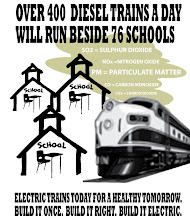
Now is the time to let Metrolinx's telemarketers know that all children, parks, daycare centers, seniors' residences, homes and schools are to be protected as the highest priority, not polluted by 464+ diesel trains passing daily through our neighbourhoods.
Build it once. Build it right. Go electric.
Metrolinx is also trying to discredit the Medical Officer of Health, Dr. David McKeown, who has said on record that he recommends electrification as the only solution, by a series of pamphlets delivered to homes along the corridor saying that Metrolinx is working collaboratively with Dr. McKeown. This is not true.
Now is the time to let Metrolinx's telemarketers know that all children, parks, daycare centers, seniors' residences, homes and schools are to be protected as the highest priority, not polluted by 464+ diesel trains passing daily through our neighbourhoods.
Build it once. Build it right. Go electric.
Sunday, September 27, 2009
Point out the White Elephant of the Metrolinx Diesel Rail Expansion!
"What we know about air pollution in Toronto is that any proposal now should pass a very stringent test before it goes forward. This proposal has not passed that test in my view. The study, conducted by Metrolinx itself, indicates clearly that there will be impacts on air quality as well as health risks for those who live close to the line."
- Dr. David McKeown
More info, link to Transit Guru Steve Munro: "Metrolinx Fudges Clean Train Info"Thank you to all who participated in the Human Train along the rail corridor! Many participants were deeply moved by the experience of walking along the tracks to connect with the railpath of communities. The protesters started in Weston, traveled down to Mount Dennis, the Junction, Wallace Bridge, and Sorauren Park, to go up Queen Street West, and to finally end up in Trinity Bellwoods Park, there to sign a huge card addressed to Premier McGuinty.
The citizens' outpouring of concern, anger, and love, urging the government to protect our neighbourhoods from the impending traffic of over 464 diesel trains a day, was extraordinary. I think this is the first time there has been a protest march organized along a railpath. As a network of communities, we are now informed, mobilized and ready for action against this project being pounded through by Metrolinx. Mike Sullivan, the co-chair of the Clean Train Coalition, noted that Metrolinx has been seen on the tracks, working already, which is in violation of formal codes of conduct during the Environmental Assessment process.
The speeches were passionate by the local politicians supporting the cause for electric trains. Cheri DiNovo, Adam Vaughan, Gord Perks, as well as Irene Atkinson, the Toronto District School Board trustee who enabled Sorauren Park to be built twenty years ago on this industrial site, spoke beautifully about the communities affected. Dr. David McKeown, the Chief Medical Officer of the City of Toronto refuted the claims by Metrolinx that the health of the residents would not be in jeopardy by the expanding GSSE/UPRL diesel traffic, and supported the communities' right to voice their strong opposition.
Liberal MP Gerard Kennedy for Parkdale-High Park outlined his opposition to the project, which is to have a moratorium on all infrastructure development for one year while electrification is studied thoroughly, whereas the Liberal MPP for the Davenport Riding, Tony Ruprecht, was nowhere to be found. Curious that those who represent the ridings which will be most negatively affected, and are legally designated most at risk socially, have been cautious to offer their support...why? And why are these vulnerable and priority neighbourhoods not being protected by their federal and provincial representatives? Is it that they are Liberals, and so is Premier McGuinty, and SNC-Lavalin is one of the major campaign contributors to the Liberal Party?
I have worked hundreds of hours to research this GSSE/UPRL diesel expansion, and I think that it should be legally decided that Metrolinx, as an arm's length agency of the province, is in direct conflict of interest with the goal of the City of Toronto, and the Greater Toronto Area, to support the objectives of public, accessible, clean transportation by privileging private-public partnerships for diesel infrastructure above the health of GTA citizens, as a matter of prudent avoidance for future health risk. If this were decided, the current Metrolinx Board of Directors, comprised of those vetting the interests of private corporations, could be formally dissolved, so that nonpartisan experts on transit could be instated, and Metrolinx could start the real work of electrifying the corridor.
As an artist, educator, and homeowner, when I get enraged, I get ingenious. My response, and gift to the Human Train Parade, was to make the obvious, obvious, and point out the White Elephant in the room. So I made a White Elephant, and here is the content of my broadside I distributed to those who attended the rally at Sorauren Park. We walked to Trinity Bellwoods, with the White Elephant balanced on the head of my 6'5" friend, Karl Junkin, and its body comprised of four white umbrellas naming the volatile organic compounds, the pollutants, and the ultrafine particulate matter, which will be emitted by exhaust hose pipe of these trains, carried by other members of the Clean Train Coalition, following along behind him.
The Absurd Transit Definition of the White Elephant:
n.
- A rare, expensive diesel rail expansion that is a financial, social and health burden for taxpayers to maintain.
- Something of dubious or limited value in fulfilling public transportation needs.
- 464 diesel trains daily as an article, ornament, or household utensil not wanted by the residents of the Greater Toronto Area.
- Publicly subsidized, privately owned transportation that is expensive to maintain, and generates too little revenue to pay for itself.
- Any transit investment that nobody wants because it is unprofitable, and so is quickly politically abandoned by its owner, Metrolinx, and the provincial government, after its utter uselessness is proven. (See also 1950s Blue 22 retrofitted rail cars for the Union-Pearson Rail Link.)
- An endeavor or venture that proves to be a conspicuous failure.
- A papier-mâché elephant created by an outraged member of the community who refuses to pay the future, ongoing health, social and financial cost of absurd transit planning.
- Or unlike this case: An electrified rail system used as the inner city norm, and Environmental Protection Act standard, throughout the world.
Historically, the White Elephant has a precedent - the "Big Owe" Olympic Stadium in Montreal, built for the 1976 Olympics, which Montreal finally paid off in 2006. The difference is that the pollution from GSSE/UPRL rail corridor will be far more actively destructive to the health of the residents than the big white eyesore of a stadium ever has been.
Human Train Media Coverage:
This is the link to the article from the Toronto Star: 'Diesel fumes unhealthy, MD tells train protest'.
This is the link to the video of 'Postcards to the Premier'. This video is a touching petition by the west end citizens to Premier McGuinty, captured during the Human Train.
This is the link to an insightful political analysis of the Environmental Assessment Process by John LaForet.
Wednesday, August 12, 2009
Design Amuck: ''Who's my Province, Premier McGuinty?"

The City of Toronto prides itself as promoting, supporting, and developing the 'creative class', yet Metrolinx has been given a provincial mandate to impose a diesel rail corridor eight times its current capacity through the Queen West Arts District, slated to run past the Gladstone, the Drake, Artscape, MOCCA and numerous galleries and artists' studios by 2014. As a friend said, "they will be washing the windows at the Gladstone every 15 minutes" as the GSSE/UPRL runs a continual, noisy wall of traffic within 100 meters of its designated heritage windows.
How is it that the City of Toronto has created a consultancy seat at MaRS for Richard Florida, author of 'Who's your City?', so that his views on developing the creative society are embedded in the urban fabric of the City of Toronto, yet Metrolinx, as 'an arms length agency of the provincial government', is intent upon destroying this creative society which adds so much to the cultural vibrancy of this city? How many events do the Gladstone and Drake host for the Toronto International Film Festival, music festivals, and visual artists? The value given to international visitors, and GTA residents, by the Queen West Arts District is immeasurable. All the venues which enable this area to thrive and grow, and for artists and filmmakers to work and live, should be protected by Metrolinx, not destroyed by the soot, vibration and noise of continuous diesel traffic. Heritage buildings will be eroded by the increased nitrous oxide and sulfur dioxide, and lung capacity and quality of life of those who live in the cultural sector will be diminished in the path of these 464+ trains daily.
Europe has been combatting the erosion of the facade of their heritage buildings by smog for years - why would a project be allowed in the GTA which will hasten our built environment's deterioration when Europe uses electric trains to protect their residents' health and preserve their historic buildings? How are the environmental and cultural policies of the City of Toronto so progressive, and those of Metrolinx, thus the Province of Ontario, so retrogressive, and actively destructive to the GTA? To paraphrase Richard Florida, "Who is my province, Premier McGuinty, and how has Metrolinx been allowed to pollute our neighbourhoods, schools and creative communities?"
As currently drafted, the GSSE/UPRL is the worst case study of bad design in urban planning imaginable, and should be requisite study for every urban planning and design student as such. There has been no intelligent design in the planning of this corridor, and no consideration for communities, or their social and cultural capital. It appears as if an engineer sat down, drew a thick line on the pre existing corridor through neighbourhoods and communities, looked up from their drafting board 15 minutes later, and with a sigh, said 'done'. This is railway engineering - not urban planning- which puts the vibrancy and health of the cultural sector, heritage buildings and tourism at dire risk. Metrolinx has held several design charrettes for community feedback, such as those in Weston, and has acted in bad faith by agreeing to the community's input, but not including the revised design from the charrettes in their final version of their Environmental Project Report.
I teach animation, and I think of the famous last scene of 'Duck Amuck' by Warner Brothers. Daffy Duck has been put through his paces by an unseen animator controlling his every movement. He has been drawn and erased to be made into a screwball, placed on a tropical island, and suffocated by an encroaching black hole of an iris in, which envelopes him in darkness, and through which he pokes his head to plead for mercy from his tormentor. At the end of the short, the camera pulls out from the edges of the animation cel to reveal the drafting table, and who is the animator and director of his fate? His arch nemesis, Bugs Bunny.
Daffy Duck in this animated short reminds me of how I feel about Metrolinx. Here is a puppetmaster, Bugs Bunny, who is engineering my demise - the loss of value in my home, the degradation of my own health, and the health and welfare of the cultural communities and educational institutions around me - to privatize our public transit system to enable SNC-Lavalin to reap corporate profit. And the only recourse I have had is to protest to Metrolinx, who has provided an Environmental Project Report so skewed in its findings, our research scientists find it unintelligible in its analysis of basic statistical data about the diesel emissions, especially as fine particulate matter below 2.5 microns is not included in their data. How frightening is this? As scientific research is still in the process of discovering the exceptional toxicity of diesel emissions, a significant portion of its most potent toxic particulate matter is not included in the EPR as it is beyond the technical scope of current scientific measurement.
In addition, as part of Metrolinx's Environmental Project Review (EPR), only a portion of cultural venues and heritage buildings are listed in their study. Many more heritage buildings, artist run centers, and cultural venues, including those in Weston, Liberty Village and Mount Dennis, are not listed as they are not yet officially designated as heritage buildings or cultural centers of provincial importance.
If you would like to point out this omission, now is the time to do so. Those who protect these heritage buildings, and represent cultural venues, should add their properties and venues to be preserved to the official list by writing letters to the Ministers of Environment, Culture and Tourism to contest their exclusion in Metrolinx's EPR. For heritage buildings, it is helpful to include research on the adverse affects of pollution on their architectural structure.
Otherwise, the GTA stands to lose what is the heart of soul of its artistic and cultural life, and which is central to the vibrancy of our culture. Every urban planning and historical preservation society, architecture program, and educational institution which teaches urban planning and design and environmental science - such as Sheridan, OCAD, George Brown, and the University of Toronto - and their practitioners, professors, and students need to band together to protest this environmental travesty, which runs counter to the cultural and environmental goals of the City of Toronto, by writing letters to Premier McGuinty, and the ministers in charge of tourism, the environment, heritage and culture.
This GSSE/UPRL project is a profoundly thoughtless and destructive design by railway engineers and businessmen, not by urban planners.There is also a conflict of interest between an arms length provincial agency and the Environmental Assessment process. Metrolinx has commissioned the writing of the Environmental Project Review through environmental consulting firms of their choice, yet has previously established contracts with SNC-Lavalin to provide diesel infrastructure. Therefore, it is in their best interest to aggregate and analyze the environmental data to protect their previous investment in diesel infrastructure, and use the lowest grade materials for building this infrastructure, despite maintaining the illusion of community input through charrettes and public consulting sites. Metrolinx will maintain the diesel status quo at any cost to the community they serve, despite the moral imperative of a government agency to protect the health of its citizens as its first priority. In effect, if diesel infrastructure is implemented, tax payers will be paying to have their health jeopardized, and their property devalued, which can become the basis of a potential class action suit if this project is implemented as designed, and residents' health along the corridor is compromised as a result.
Metrolinx has just signed the first part of the contract with SNC-Lavalin to ensure that they will build the infrastructure, but has not yet signed the second part, which determines which type of infrastructure will be used. There is still a very short time to determine that this future infrastructure is entirely electric, and that no more diesel infrastructure is purchased.
Those intent on protecting heritage buildings and developing social and artistic capital, please make your voices heard to Premier McGuinty, the Minister of Environment, John Gerretsen, Minister of Culture and Minister Responsible for Seniors, Aileen Carroll, Minister of Canadian Heritage and Official Languages, Jim Moore, and Minister of Tourism, Monique Smith, Minister of Transport, Jim Bradley, before the analysis of the Environmental Project Review ends on August 31st by hard copy letters and email, and please carbon copy info@cleantrain.ca for our records. Just cut and paste following email addresses into your send box, (and address the email to the previously listed names): McGuinty.D@parl.gc.ca, minister.moe@ontario.ca, info.mcl@ontario.ca, jbradley.mpp.co@liberal.ola.org,info@pch.gc.ca, info@cleantrain.ca, Smith.m@parl.gc.ca
Our arts and culture community must demand 'Clean Air for Vibrant Cities' to protect the cultural heart and soul of our city - the Queen West Art District, and all of the historic properties and cultural venues along this rail corridor. We are very close to being too late to protect what the City of Toronto and the GTA has been determined to support, preserve and develop - our cultural and architectural identity. Please join us in asking: "Who is my province, Premier McGuinty, and why are you not interested in protecting us?"
Join the Clean Train Coalition in 'The Human Train, A March for Clean Air for Vibrant Cities', which will take place on Saturday, September 26th along the rail corridor. Details will be posted on this blog soon.
Favourite Quote of the Week: "Why Ride the Toxic Train in Toronto, when you can Ride the Wind in Calgary?" Quote by Joanne B., as posted on the Metrolinx Consulting Site.
References:
MaRS at http://www.marsdd.com/MaRS-Home.html, Richard Florida on the Creative Class athttp://www.creativeclass.com/, and "Duck Amuck" Chuck Jones, Warner Brothers, 1953, 6:59, considered one of the greatest 50 cartoons of all times by critics at http://www.youtube.com/watch?v=WahJLv65S-U
Factual information on 'The Big Move' can be found in a brochure at Metrolinx's site at http://www.metrolinx.com/thebigmove/brochure/default.aspx
Thursday, July 23, 2009
Going Electric in Metrolinxland
The Clean Air for Little Lungs Stroller Parade was a resounding success! 450+ parents, toddlers, caregivers, supporters and grandmothers showed up to strut their stuff to Soli and Rob performing such classics as 'Peee...Uuuu...Metrolinx Stinx' and electrified variations of childhood favourites, 'Electric Avenue' and 'Dalton Blow your Horn', as well as their own anthem, 'Go Electric'.
Thank you to all who took time from their busy schedule to say 'no' to childhood asthma and diminished lung capacity. Your collective show of will is heartwarming and courageous in the face of an arm's length provincial agency, Metrolinx, which thinks that honouring a 1999 contract with SNC-Lavalin to run over 140 diesel trains for the Union-Pearson Rail Link through our neighbourhoods daily is more important than your children's health. We will win this outrageous contest of wills, and corporate backroom gladhanding, and this demonstration was ten large baby steps in the right direction.
During the speeches, Dr. Ian Clarke, from Sick Kids, said that the synergistic combination of nitrous oxide and particulate matter from diesel emissions would be 354% higher than permissible environmental standards. When he asked Metrolinx why they had not studied electric trains rather than diesel during one of their Open Houses, they said "Why would we do that? Everyone knows that electric trains are better for the environment."
In particular, electric trains are much better for the lungs of young children as they have no toxic emissions. Children breathe twice as quickly as adults as their metabolism is twice as fast. As a result, the development of their lung capacity is curtailed by the absorption of fine particulate matter from diesel emissions during their childhood for the remainder of their lifespan. In the words of Sophia Wong, one of the organizers of the Clean Air Little Lungs Parade, (and I have to admit, I was one of the others), "My child is two now. In fifteen years, when this rail corridor is slated to be electrified, and my child is seventeen, when he says that he is going to play soccer, I will have to remind him to take his puffer- if he can play soccer at all due to his asthma."
Meanwhile, our tax money has just paid for an 800 page analysis by Intrinsik, an environmental consulting firm, which says that the airshed of 300 000 people 'in the strike corridor' will be poisoned within legal limitations. After the cover page of their Air Quality Assessment Report as commissioned by Metrolinx, there is a disclaimer by Intrinsik stating that they cannot be held legally liable for the content of this report. Who wrote this disclaimer - the Red Queen from 'Alice in Wonderland'? This disclaimer, for me, says it all - Metrolinx will not be held responsible for polluting the lungs of the residents of Toronto as they are, first and foremost, a corporate entity fulfilling their corporate contracts and provincial mandate to save money in every way possible by implementing retrofitted diesel trains from the 1950s for the UPRL. Strike corridor, indeed, as we will breathe daily this airshed's adverse effects. Is this really a term generated from an Air Quality Assessment Report that is designed to protect the health of citizens, Premier McGuinty?
My second favourite Alice in Wonderland remark, other than the disclaimer by Intrinsik, is the quote by Brian Peltier, Metrolinx's executive lead of this project, published in The Sun, stating "That analysis showed very clearly that the impacts being talked about are just not there. I think it's really good news that we can do this rail expansion with very little impact on air quality." I would like to extend a sincere invitation to Brian Peltier to invest in a condominium being built within 30 metres of the strike corridor as so many have done without foreknowledge of this rail expansion. Developers have been told to redesign their blueprints to not to include windows in the first three floors of these new condominiums due to the amount of soot these floors will collect from this diesel rail traffic.
To their credit, Metrolinx has established a Community Advisory Committee for Electrification comprised of sixteen community appointees who have expertise in urban planning and development, workplace health, engineering, and social innovation. This is positive news, however, as this is the eleventh study for the study for electrification during this long, arduous process of protecting this diesel rail expansion in the most ludicrous, involved manner imaginable, it is a trifle suspect. Really, Lewis Carroll could not have dreamed of a Wonderland in which the general public has paid for an Air Quality Report which says that over 464 trains a day would make no difference to the noise and vibration levels and air quality as they pass directly beside their homes, as well as ten studies trying to prove that electric trains are not better than diesel.
I want to ask every executive at Metrolinx who has children and elderly parents, especially Brian Peltier - at what length would you go to protect your own health, and your family's future health, from this level of toxicity in your neighbourhood? And why are we, in the 416 region, paying your agency $5 million of our tax money to have you convince us that diesel emissions are not toxic because you want diesel trains to hurtle their way through our inner city neighbourhoods on their way to your suburban homes in the 905, without even stopping to pick us up?
Brian Peltier Quote Reference and Video of the Stroller Parade:
Toronto Sun 'Residents want train derailed:
Rally at Queen's Park to demand halt to use of diesel engines on planned Union-Pearson rail line'
By JONATHAN JENKINS, QUEEN'S PARK BUREAU at http://www.torontosun.com/news/torontoandgta/2009/07/20/10199731.html#/news/torontoandgta/2009/07/21/pf-10202501.html
Friday, July 3, 2009
"Clean Air for Little Lungs Stroller Parade": Monday, July 20th 10-11 am Queen's Park

A Callout to Parents, Caregivers, their Supporters, and Children!
Event: "Clean Air for Little Lungs Stroller Parade"
When: Monday, July 20th, 10 - 11 am
Where: In front of the Ontario Legislature (Queen's Park)
Why: Parents say NO to over 400 dirty diesel trains a day running through our neighbourhoods. For the sake of our children's health, tell Premier McGuinty that electric trains are the only solution. Bring your kids and noisemakers.
Featuring a musical performance by children's entertainers, Rob and Soli of Alistair Ant Productions.
For more information, go to http://www.cleantrain.ca and register through the Clean Train Facebook site to the "Clean Air for Little Lungs Stroller Parade" invitation list to RSVP.
As an educator, I support the Clean Train Coalition's Stroller Parade as research has proven that diesel emissions can:
- impair lung development and lung capacity in children
- decrease school children's ability to learn and retain information
- increase the incidence of childhood asthma
The recent Air Quality Assessment Report by Metrolinx admits that this GSSE/UPRL diesel corridor expansion will emit nitrous oxide levels far beyond legal limitations. There are 76 schools, 96 daycare centers, and 4 long term care facilities, (including one chronic respiratory care hospital), within 1 km of this expansion whose school children and elderly residents will be negatively affected by these tonnes of nitrous oxide and particulate matter emissions. Children are particularly vulnerable due to the small particulate NOx matter impairing the growth of their lungs and diminishing their future lung capacity.
Come and protect the future health of our children!
Tuesday, June 23, 2009
Diesel in, Diesel Out
Vancouver gets Canada Line- an electric Air Rail Link for their 2010 Olympic Games which will open three months before schedule. Calgary gets a renewable energy-driven electric rail system, powered by wind turbines. Toronto gets a 145 page report, commissioned by Metrolinx, from an environmental consulting firm stating that our health will be damaged 'within established standards' by over 400 diesel trains a day running through our neighbourhoods. Diesel in, diesel out - garbage in, garbage out. If a report is written using the worst case diesel emissions data to generate air quality results, the worst case air quality assessment will have to be carefully skewed by those who write the report to justify the expenditure on diesel trains, and protect the 'necessity' for diesel emissions into our air, soil and water sheds. And don't forget our homes and lungs.
What gives? Don't we deserve a better, cleaner and quieter train system like the rest of Canada? And why can SNC-Lavalin work with InTransitBC in Vancouver to build an automated light rapid rail system, but not work to utilize the same electric train technology for the Georgetown South Service Expansion with Metrolinx in Toronto? Why is Metrolinx still commissioning Air Quality Assessment Reports on the implementation of a diesel train corridor in Toronto? Why would the same transit company, SNC-Lavalin, go back in time to use diesel trains in a private public partnership in Toronto, when SNC-Lavalin has proven expertise to build an electric train system in Vancouver in exactly the same capacity?
Let's look at this logistically. Our taxpayer's money is being spent by Metrolinx on an Air Quality Assessment Report that justifies this logic - since the west end of Toronto's air quality is so bad already, a 'negligible' increase of 15% air pollution is considered irrelevant as added to this region's air quality by this rail corridor. This includes the fact that these diesel trains will be the greatest source of emissions for nitrous oxide in all of Toronto, and that these standards are far beyond legal guidelines. If the west end of Toronto's socioeconomic population is considered at risk, as well as this region, one of the most polluted regions in all of Ontario, would it not be logical to protect this at risk population and region, rather than adding to present environmental stressors? Why would a diesel corridor even be considered to be built in a region which has the greatest number of 'sensitive receptors' - young children - per capita when this region's existing air quality is already benchmarked as the worst in Ontario?
Enough already, Metrolinx. Use the proven track record of SNC-Lavalin to build electric trains in Vancouver for the GSSE in Toronto. Improve upon what SNC-Lavalin has learned in Vancouver while building this electric train system to adapt it to specifically meet the needs of the GTA. Work with the municipal government's TransitCity to streamline this rail corridor so that it works as a comprehensive transit system which does not duplicate services, such as the Air Rail Link provided by the Eglinton LRT, but supports an easily accessible, clean, unified transit system for the people that matter most- the passengers and those who live near the corridor.
Time's a-wasting. Our health is worth more than yet another report.
References: Canada Line at http://www.canadaline.ca/ and their FAQs at http://www.canadaline.ca/aboutFAQ.asp
GSSE and UPRL EA - Human Health Assessment of Air Quality Impacts June 2009 Intrinsik Environmental Sciences Inc. Link to http://www.metrolinx.com/gsse/docs/GSSE_UPRL_EA-Human_Health_Assessment-Air_Quality_Impacts-Full_Draft_Report-June-09.pdf
Saturday, May 16, 2009
Democracy and Metrolinx? No way.
Fair Political Representation without Corporate Conflict of Interest, and Primary Health Prevention:
Canada is a democracy. As it is a democracy, residents of Toronto should have City Councillors as representatives on the Board of Directors of Metrolinx who express our grave concerns about this rail expansion in our neighbourhoods. Mayor Miller, who has worked so hard to implement greening measures in the City of Toronto, and Councillor Giambrone, the chair of the TTC, have been removed as our last representatives from Metrolinx' Board of Directors. Therefore, the residents of Toronto no longer have any representation for this project on Metrolinx at all.
By replacing Toronto's representatives entirely with Board of Directors on Metrolinx who actively represent the industrial, corporate interests of the rail expansion, these new Board of Directors have a direct conflict of interest with an unbiased Environmental Assessment and the democratic rights of the residents of Toronto to protect our quality of life and health. They will vote in favour of infrastructure implementation as their corporate interest.
Moreover, as primary prevention in the healthcare community becomes internationally accepted as the norm to prevent the creation of carcinogens at the source (in this case, diesel emissions), thereby future medical treatment, the federal and provincial governments are in direct conflict with their role as advocates for a healthy society. Will the federal and provincial government be prepared to carry the costs of medical treatments for the respiratory ailments that they have incurred in this rail corridor through these self-generated diesel emissions? Is it not contradictory that this corridor will put at risk children in parks and schools, hospitals nearby the tracks, and the elderly in nursing homes- all institutions that the government funds? Why would the federal and provincial government choose to undercut their support of federally and provincial institutions and faciliities by choosing to pollute the environment around the facilities that they have built and funded? This is an even greater conflict of interest of public interest with corporate investment, and indicates that the federal and provincial government no longer represents or protects its citizens.
Canada is a democracy. As it is a democracy, residents of Toronto should have City Councillors as representatives on the Board of Directors of Metrolinx who express our grave concerns about this rail expansion in our neighbourhoods. Mayor Miller, who has worked so hard to implement greening measures in the City of Toronto, and Councillor Giambrone, the chair of the TTC, have been removed as our last representatives from Metrolinx' Board of Directors. Therefore, the residents of Toronto no longer have any representation for this project on Metrolinx at all.
By replacing Toronto's representatives entirely with Board of Directors on Metrolinx who actively represent the industrial, corporate interests of the rail expansion, these new Board of Directors have a direct conflict of interest with an unbiased Environmental Assessment and the democratic rights of the residents of Toronto to protect our quality of life and health. They will vote in favour of infrastructure implementation as their corporate interest.
Moreover, as primary prevention in the healthcare community becomes internationally accepted as the norm to prevent the creation of carcinogens at the source (in this case, diesel emissions), thereby future medical treatment, the federal and provincial governments are in direct conflict with their role as advocates for a healthy society. Will the federal and provincial government be prepared to carry the costs of medical treatments for the respiratory ailments that they have incurred in this rail corridor through these self-generated diesel emissions? Is it not contradictory that this corridor will put at risk children in parks and schools, hospitals nearby the tracks, and the elderly in nursing homes- all institutions that the government funds? Why would the federal and provincial government choose to undercut their support of federally and provincial institutions and faciliities by choosing to pollute the environment around the facilities that they have built and funded? This is an even greater conflict of interest of public interest with corporate investment, and indicates that the federal and provincial government no longer represents or protects its citizens.
Monday, May 11, 2009
Diesel Trains are so Yesterday: An Open Letter regarding the Metrolinx Corridor Expansion
This is the first letter I sent to the Prime Minister, City Councillors, the MPs, and the MPPs, hence the tone. I was just starting to put all the facts together, and was horrified:
I am a Toronto resident who is very concerned about the expansion of the Georgetown corridor (including the Union-Pearson Rail Link) and Newmarket corridors using diesel trains. The construction on this project begins in 2010, and the Environmental Assessment process has been shortened to four months to be completed on July 30th.
This rail expansion should use electric trains to ensure that significant environmental concerns are resolved, and the expansion of this service does not merely shift the cause of pollution from highways to rail corridors. These rail corridors run beside schools, nursing homes, playgrounds and through residential neighbourhoods. The rights of the citizens who use these services, and live in these areas, should be considered as a major part of the Environmental Assessment process.
Also, the $875 million cost of this project is carried by taxpayers, and should be supported by those who will be affected most as the construction from the expansion disrupts neighbourhoods for years at a time. If the rail expansion is electric, the neighbourhoods will be more likely to support this massive project. The neighbourhoods will have difficulty dealing with the second disruption of their lives, if indeed, the rail corridor is to be electrified in 15 years as promised. Historically, it is rare that major public works are upgraded years after their construction, so this corridor should be built properly the first time as electric.
My specific concerns are as follows:
The hours of operation are cited as 5:30 am to 12:30 am each day. Due to these long hours, it is beholden to Metrolinx, and by extension the Government of Ontario and the Government of Canada, to ensure that these trains are quiet, efficient, and non-polluting, as these hours of business extend far beyond noise restrictions for normal business hours.
The data from the Environmental Assessment of the Georgetown and Newmarket corridors, and the Union-Pearson Rail Link, should be merged and considered as one study as these two corridors, and the rail link, are contained within the very small, area of study entitled 'The Davenport Diamond' by Metrolinx. The Environmental Assessment should consider the proximity of these corridors south of Dundas, and include both lines of the rail expansion and UPRL as part of the overall environmental impact concurrently. Metrolinx has said that they will consider these Environmental Assessments separately, although these corridors are in the same neighbourhood. This does not seem to lead to conclusive data.
Diesel trains create significant CO2, NOx and SO2 and particulate matter emissions. Neighbourhoods are willing to accept the increased traffic (at a projected 300 - 500 trains a day) for the common good, but are legitimately concerned on the effect of this air and noise pollution on their health, welfare, and businesses.
The Metrolinx report states the diesel emissions will affect only 500m from its origin, but as the City of Toronto, and the GTA has become more dense in population, this is affects a very large area and population. The Metrolinx report has not updated its data on the population affected by the expansion to be up-to-date.
Urban planners and transportation analysts also know that traffic expands given the avenues available to it, and that the increased traffic on the rail corridor, airports and highways, will impact the quality of air in Ontario for generations to come. As a result, it should be imperative to construct an electric train now to attempt to offset the carbon emissions of the rail corridor component of this transportation expansion. There will be more than enough adverse environmental affects with the increasing airport and highway traffic in the future of the GTA.
Most countries in the world are developing completely electrified rail systems- including India and the United States- and Canada, as a wealthy nation, should be one of them. Why are we considering a technology which is far behind the TTC street car- an electric train which is already in successfully used throughout the City of Toronto? This rail corridor should set an environmental precedent for transit initiatives to come, as the Lakeshore GO train will be electrified in the near future, and so that these corridors are consistent with the American rail system.
Why is Metrolinx, and by extension the provincial and federal government, not performing international 'best practice' case studies of inner city and suburban transit initiatives to try to mitigate the environmental repercussions of this rail expansion on the GTA? There is nothing 'sustainable' about diesel trains, as cited in the Metrolinx report- just retrograde.
TransitCity, as projected by the City Council of Toronto, has proposed a GO train as the fixed link to Pearson Airport- why are SNC-Lavalin's 140 a day, two engine, refurbished 1950s diesel engines considered as a viable, environmentally sound alternative to the LRT as proposed by the City Council to be provided by the GTA, SNC-Lavalin's proposal was written in the 1990s, and is no longer valid as a solution to this rail link by targeting a limited market for the business class.
It is very important that the projected ridership on this rail corridor is studied in detail, and at this time, for its actual market need, and monitored as it is implemented, so that there is not empty space and excess capacity on these trains. The rail corridor should be also monitored and assessed frequently as it is used, so that its implementation and use are consistent with its environmental and social 'Return on Investment'. This rail corridor should not create more air and noise pollution from its traffic than it offsets.
In conclusion, as global warming continues as the most pressing concern internationally, it imperative that every major infrastructure project is considered with great intelligence, foresight and environmental analysis. This project is of the magnitude of the Big Dig in Boston, which wreaked havoc on Boston for years. Therefore, it is better that more planning and analysis is applied to these infrastructure plans before the project is built, as the cost of this project environmentally will be carried by the generations who live in Ontario for decades to come.
Ultimately, if this rail expansion is made electric, there will be even more jobs created for Ontario workers, and opportunities created for companies, as part of the greening research and development initiatives internationally. This advanced technology and intellectual property can then be exported to become a positive part of our legacy and international corporate reputation.
I am a Toronto resident who is very concerned about the expansion of the Georgetown corridor (including the Union-Pearson Rail Link) and Newmarket corridors using diesel trains. The construction on this project begins in 2010, and the Environmental Assessment process has been shortened to four months to be completed on July 30th.
This rail expansion should use electric trains to ensure that significant environmental concerns are resolved, and the expansion of this service does not merely shift the cause of pollution from highways to rail corridors. These rail corridors run beside schools, nursing homes, playgrounds and through residential neighbourhoods. The rights of the citizens who use these services, and live in these areas, should be considered as a major part of the Environmental Assessment process.
Also, the $875 million cost of this project is carried by taxpayers, and should be supported by those who will be affected most as the construction from the expansion disrupts neighbourhoods for years at a time. If the rail expansion is electric, the neighbourhoods will be more likely to support this massive project. The neighbourhoods will have difficulty dealing with the second disruption of their lives, if indeed, the rail corridor is to be electrified in 15 years as promised. Historically, it is rare that major public works are upgraded years after their construction, so this corridor should be built properly the first time as electric.
My specific concerns are as follows:
The hours of operation are cited as 5:30 am to 12:30 am each day. Due to these long hours, it is beholden to Metrolinx, and by extension the Government of Ontario and the Government of Canada, to ensure that these trains are quiet, efficient, and non-polluting, as these hours of business extend far beyond noise restrictions for normal business hours.
The data from the Environmental Assessment of the Georgetown and Newmarket corridors, and the Union-Pearson Rail Link, should be merged and considered as one study as these two corridors, and the rail link, are contained within the very small, area of study entitled 'The Davenport Diamond' by Metrolinx. The Environmental Assessment should consider the proximity of these corridors south of Dundas, and include both lines of the rail expansion and UPRL as part of the overall environmental impact concurrently. Metrolinx has said that they will consider these Environmental Assessments separately, although these corridors are in the same neighbourhood. This does not seem to lead to conclusive data.
Diesel trains create significant CO2, NOx and SO2 and particulate matter emissions. Neighbourhoods are willing to accept the increased traffic (at a projected 300 - 500 trains a day) for the common good, but are legitimately concerned on the effect of this air and noise pollution on their health, welfare, and businesses.
The Metrolinx report states the diesel emissions will affect only 500m from its origin, but as the City of Toronto, and the GTA has become more dense in population, this is affects a very large area and population. The Metrolinx report has not updated its data on the population affected by the expansion to be up-to-date.
Urban planners and transportation analysts also know that traffic expands given the avenues available to it, and that the increased traffic on the rail corridor, airports and highways, will impact the quality of air in Ontario for generations to come. As a result, it should be imperative to construct an electric train now to attempt to offset the carbon emissions of the rail corridor component of this transportation expansion. There will be more than enough adverse environmental affects with the increasing airport and highway traffic in the future of the GTA.
Most countries in the world are developing completely electrified rail systems- including India and the United States- and Canada, as a wealthy nation, should be one of them. Why are we considering a technology which is far behind the TTC street car- an electric train which is already in successfully used throughout the City of Toronto? This rail corridor should set an environmental precedent for transit initiatives to come, as the Lakeshore GO train will be electrified in the near future, and so that these corridors are consistent with the American rail system.
Why is Metrolinx, and by extension the provincial and federal government, not performing international 'best practice' case studies of inner city and suburban transit initiatives to try to mitigate the environmental repercussions of this rail expansion on the GTA? There is nothing 'sustainable' about diesel trains, as cited in the Metrolinx report- just retrograde.
TransitCity, as projected by the City Council of Toronto, has proposed a GO train as the fixed link to Pearson Airport- why are SNC-Lavalin's 140 a day, two engine, refurbished 1950s diesel engines considered as a viable, environmentally sound alternative to the LRT as proposed by the City Council to be provided by the GTA, SNC-Lavalin's proposal was written in the 1990s, and is no longer valid as a solution to this rail link by targeting a limited market for the business class.
It is very important that the projected ridership on this rail corridor is studied in detail, and at this time, for its actual market need, and monitored as it is implemented, so that there is not empty space and excess capacity on these trains. The rail corridor should be also monitored and assessed frequently as it is used, so that its implementation and use are consistent with its environmental and social 'Return on Investment'. This rail corridor should not create more air and noise pollution from its traffic than it offsets.
In conclusion, as global warming continues as the most pressing concern internationally, it imperative that every major infrastructure project is considered with great intelligence, foresight and environmental analysis. This project is of the magnitude of the Big Dig in Boston, which wreaked havoc on Boston for years. Therefore, it is better that more planning and analysis is applied to these infrastructure plans before the project is built, as the cost of this project environmentally will be carried by the generations who live in Ontario for decades to come.
Ultimately, if this rail expansion is made electric, there will be even more jobs created for Ontario workers, and opportunities created for companies, as part of the greening research and development initiatives internationally. This advanced technology and intellectual property can then be exported to become a positive part of our legacy and international corporate reputation.
Subscribe to:
Posts (Atom)