Showing posts with label City of Toronto. Show all posts

Friday, July 29, 2011

Playing with Team Ford

“It is clear that there is a program to eliminate the public from our great city.”
- Kim Fry, the 11th deputant during the Core Service Review at Toronto’s City Hall on Thursday July 28
For a penny-pinching populist, Mayor Rob Ford’s policies are very expensive. Since his October 25th election, he has spent over $533 million in a strange sibling rivalry against his arch nemesis, ex-Mayor David Miller. During Miller’s time in office, Rob Ford was the least respected councillor, and was relegated to the benches during Miller’s confabs with his handpicked, executive council. In retaliation, cribbing from his tactics as high school football coach, Ford has crafted his defensive lineup - an executive council of six strong ‘yes’ men to systematically take apart Toronto’s public infrastructure – which Miller intended to be his legacy - through cutting core services. Ford is like a younger kid brother knocking down the carefully placed building blocks of his brother’s toy castle because he does not know how to build a city of his own design or imagination.

Select items from a spreadsheet itemizing Mayor Ford’s expenses to the City of Toronto? Canceling Transit City, initial penalties of $179 million, removing bike lanes, $469,000, bailing out an under-used arena, $43.4 million, subsidizing an underused ski lift in the ward of his ally, Councillor James Pasternak, $2 million, and the loss of revenue from the Land Transfer Tax and Vehicle Registration Tax, $204 million and $50 million respectively. Another $100,000 was spent to hire a TTC consultant, and $3 million to hire KPMG, an external consulting firm- both of these expenses are part of city councillor’s jobs, and so are redundant.

While ex-Mayor Miller left a $375 million surplus, Mayor Ford is dangerously close to spending money equivalent to the $774 million budget deficit he wanted to balance by 2012. Left unchecked, these expenditures will almost double the projected 2011 deficit within his first year of office, showing the true cost of privatization. With over three years left in his term, he huddles with his brother, Doug, as his closest advisor, quietly strategizing during City Council meetings, cautioned by his rightwing consultants to remain tightlipped with the media.

Ford’s first agenda item was to hire consultancy firm, KPMG, to perform a core service review. When KPMG’s results were made public, the results backfired for Team Ford. 96% of services are mandated by the federal government, there was no gravy, and the report unintentionally highlighted that the previous surplus left by ex-Mayor Miller was an act of financial wizardry. Apparently, the left can be bean counters, too.

On July 28th, there were over 300 deputations at City Hall on the agenda, with irate citizens decrying these cuts, and police at the council chamber’s door; the new executive council will make the final decision regarding these core service cuts in September. Bowing under thousands of emails of public pressure to attend the deputations- Mayor Ford did not sit in for the first round - he decreed that they take place over a marathon 20 hours. The deputations have become a kangaroo court, a sham procedure, to get them out of the way of his city fire sale, as ‘efficiencies’ are found, cutting core services from the elderly, children, those with HIV, caretakers, bicyclists, and at risk youth, including a program that funds 685 student nutrition programs, 42 AIDS prevention projects and 38 community drug prevention programs. Although police refused access to City Hall’s green roof for his picnic, activist Dave Meslin is part of hundreds attending a City Hall slumber party tonight; internationally, other cities are taking over squares to protest similar austerity measures.

By pitting the KPMG report against community deputations, Team Ford has deliberately polarized the downtown core against suburbanites. Call it ‘wedge politics’, ‘culture wars’ or ‘divide and conquer’, it is a tactic used to distract GTA citizens as hard won public assets are sold off to invisible bidders. Think of the Canadian version of Koch Brothers as high school football coaches, rather than democratic mayors, with transit at the center of the debate.

Ex-Mayor Miller’s legacy was to be Transit City, a light rail network designed to add street level connectivity and make workplaces accessible for outer neighbourhoods; Team Ford proposes to bring another football team and football stadium to downtown Toronto, and extend a Sheppard subway line to nowhere. ‘Austerity will not be pretty’, read a sign at the KPMG protest, but for Team Ford, stadiums, subways and athletes are certainly more important than transit, bicycle lanes, and ‘bike people’, as we are called by Councillor Doug Holyday. For the right, bike lanes are easily sacrificed on the altar of the Almighty Car, and traffic lanes and parking lots are held to be places of worship.

On July 12th, over three hundred bicyclists converged on City Hall, to ask that the newly installed Jarvis bicycle paths remain in place. Used by 890 riders daily, the bike paths connected the east end of the city with the west. Wearing bicycle helmets, and raising silently waving ‘jazz hands’ to show support for councilors arguing for their right to share lanes of traffic, a heated discussion in City Council raged over two days. Central to the debate were these questions- are bicyclists considered worthy of protection? Is Jarvis Street a cultural corridor or highway? And can a lane on Sherbourne Street, 400 m away, be considered sufficient, or do bicyclists have the right to be integrated as part of a citywide network with multiple options of bike routes?

Councillor Shelley Carroll argued that bicyclists will use Jarvis Street anyway, and modes of transport cannot be forbidden under the Highway Transport Act. Councillor Glenn De Baeremaeker said, “I think cyclists should start suing the city when struck by cars given this council's recorded indifference to our safety.” Every seven hours a bicyclist is hit in the City of Toronto.

Finally, in procedural chaos, City Council voted that the Jarvis lanes were slated to be removed in two years upon the completion of the segregated Sherbourne lanes. A calculated, last minute motion by Councillor Giorgio Mammoliti re-added the reverse fifth lane, to render the prior Environmental Assessment and consultations null and void. Feisty Councillor Kristyn Wong-Tam objected to the last minute amendment by Mammoliti about the lanes in her Ward; rightwing partisan Speaker Nunziata allowed the motion, and eight left leaning councillors walked out upon learning that they will be unable to vote upon the bike plan item by item in the future. The final blow - City staff told Wong-Tam, who is lesbian, that returning the reversible centre lane to Jarvis would cost $570,000, more than 4 times the city grant to Pride, an event which also takes place in her Ward, and is next on the chopping block. (For a detailed discussion of the vote, link here.)

Upon hearing this verdict, ever-ingenious Dave Meslin, the founder of the Toronto Bicyclist’s Union, posted a Facebook call out for riders to take back Jarvis. Two days later, 1100 respectful bicyclists, ringing their bells, circled Jarvis Street to Church Street and rode to City Hall chanting “We just want to share.” As I rode my bike down Queen Street West, an onlooker called out “Pay some taxes”, a byproduct of the new nastiness now made publicly permissible by Torontonians modeling the behaviour of our Mayor, and his allies, toward bicyclists.

In his nine months in office, Mayor Ford has shown preferential treatment for his constituents. He prefers car-drivers over bicyclists, the suburban elite over the downtown intelligentsia, the very wealthy over the marginalized, and corporations over unions. He cannot walk several minutes from his office to a podium to read a brief speech for the flag raising ceremony of Pride; he attends Caribana instead to show that while he may be homophobic, he is not racist. He makes his preferences known by picking and choosing which events to attend, and which deputations to listen to, and when frustrated by community consultation, changes access to democratic process by changing the date of motions, or by running an all-night deputation session, so that the public cannot attend, or hand signaling a councillor to add a last minute motion to stymie progressive motions.

Inappropriately, Mayor Ford has used his office to discriminate against those who are most defenseless, and in need of defense- whether bicyclists or marginalized groups. Ford as a football coach, if not as a democratic mayor, should rise to the challenge of inclusive policymaking, if he wishes to remain in his position. So should his brother, Doug. Going forward, we need to be Team Toronto, not Team Ford.

With special thanks to the blog ‘Driving the Porcelain Bus’ for the expense breakdown of Mayor Ford.

References:
‘Driving the Porcelain Bus’ at http://drivingtheporcelainbus.blogspot.com
Robyn Doolittle, Toronto Star, Urban Affairs Reporter, 'Critics see KPMG report as ‘smoke and mirrors’ at http://www.thestar.com/news/torontocouncil/article/1028588--critics-see-kpmg-report-as-smoke-and-mirrors
Matt Elliott, 'Ford for Toronto', 'The Jarvis vote: What the hell happened?' at
http://fordfortoronto.mattelliott.ca/2011/07/13/the-jarvis-vote-what-the-hell-happened/

Friday, October 8, 2010

One Toronto, Now: An Election is a Terrible Thing to Waste

Only when humans are again permitted to build authentic urbanism — those cities, towns, and villages that nurture us by their comforts and delights — will we cease the despoiling of Nature by escaping to sprawl.
Andrés Duany, 'Suburban Nation: The Rise of Sprawl and the Decline of the American Dream'
I think of Rob Ford as a powder keg, masquerading as a beer keg. At first glance, he appears populist, pleasing, inexpensive, and easygoing, and then you realize that he is elitist, divisive, and explosive. (To see Rob Ford's behaviour on City Council, here is the 'Rob Ford's Maturity' youtube video which is going viral.) As former mayoral candidate Sarah Thomson warns, the city risks “handing over the office of greatest local influence on the basis of anger and reaction, not that of responsible, thoughtful and mature policy”. Rob Ford has led a negative campaign against City Hall, and when people have been made afraid of the future, they fall back by default on conservative posturing, blinding them to socially innovative solutions. As George Smitherman seethed, "The City of Toronto’s motto is diversity is our strength. If Rob Ford is elected mayor, the first thing that will need to be done is change the motto".

Transit is by far and away the thorniest, and most important, issue in this mayoral race. Rob Ford's transit plan includes getting rid of streetcars, building suburban bicycle lanes, and extending the Sheppard subway line. By "stopping the war on cars" for his supporters, Ford has created skepticism toward Transit City's European-style Light Rail Transit system, without offering any viable alternatives. As Chris Bilton noted in Eye Weekly:
Ford’s focus on road repairs is admirable, but refuses to acknowledge that the reason we need to repair the Gardiner and the DVP is because they are used daily by 905ers whose taxes do not pay for Toronto’s road maintenance. And then there’s Ford’s totally worthless bike plan, which boasts 100km of off-road biking trails — mainly through the northernmost parts of North York and the far reaches of suburban Toronto — most of which would be completely useless to anyone trying to commute into the downtown core. Ford doesn’t seem to understand that cyclist commuters reduce traffic congestion (and transit congestion for that matter) and will ride on Toronto streets whether or not there are bike lanes. Trying to relegate cycling to a weekend pastime is not only delusional, but would make congestion worse.
Ford's slash and burn spending on transit initiatives will increase traffic congestion, air pollution, and road rage through urban sprawl, and benefit no one, while damaging everyone's health and Toronto's future economic prosperity. In addition, he is attempting to turn back the clock on Mayor Miller's legacy, Transit City, which forms the basis of network for the entire GTA, and democratizes accessibility for those who are underserved to have access to Toronto without relying on cars. Rob Ford's plan to extend the Sheppard Line has not been approved by the federal and provincial governments; Transit City has been, and is already being constructed, so the subway extension is an election promise impossible to meet.

Downtown, Ford will sell off bicycle lanes to SUVs, in a time of peak oil, when the rest of the world, including China, is building electric transit networks to espouse the principles of New Urbanism: Renewable Energy + Electric Transportation + Walkable Urbanism = Livable Cities. China, by the way, has canceled their contract with General Motors for the Hummer, knowing they would clog its arteries. China knows it does not want another 10 day traffic jam; Ford would be encouraging just that in Toronto.

I live in a triangle of three parks, Sorauren, MacGregor and Dufferin Grove, in Ward 18, part of Davenport Riding - recently singled out as 'a riding to watch' in all of the upcoming elections. Friday night suppers in Dufferin Grove are a magnet for first and second generation immigrants, designers, tradespeople, professors, those of many different genders, and priority youth - a neo-urban hippy community. This riding also has the largest growing immigrant population, and some of the greatest poverty, in Canada. We have had our growing pains, but my community believes in a bicycle lanes, farmer’s markets, and a 'Do it Yourself' culture, values which are a throwback to the Depression Era when each purchase was carefully considered, and household items were repurposed, reused, and shared through a network of neighbours. Parks are essential to the Davenport Riding. As Toronto becomes ever more crowded, they ensure equitable access to play for those who live in crowded conditions. Downtown parks are what make my urban life tolerable, and have stopped my flight to the suburbs.

One day, while watching the neighbourhood children make human pyramids in Dufferin Grove, a fridge magnet was thrust under my nose. I looked up and found it attached to Rob Ford. “Vote for me,” he said imperiously. I said “Not a chance, Rob. You know nothing about urban planning and environmentalism, the two things that matter most to this community.” “Call my office”, was his reply, and he stumbled off, with his three younger, identical acolytes in tow, like a lion stalking prey. As he approached a grazing herd of neo-urban hippies, they swiftly fled from his pack, loping like antelopes across the plains. I still wake up in the wee hours of the morning, giggling at this sight, until the seriousness of the upcoming mayoral election kicks in. I am afraid for the park system if Rob Ford is elected, and with very good reason, because the Toronto Islands are at stake as well. I love this park, and their beaches, and they are my most treasured part of Toronto.

The Toronto Islands attract 12 million visitors, including international tourists, a year to the waterfront. Ford’s decision to sit down with Porter Airline's Rob Deluce to discuss how to continue to expand the Toronto City Center Airport will jeopardize the right of those who love to picnic on the Toronto Islands- those who cannot afford to flee the smoggy heat of the city. Aircraft flying directly above the Islands, and Lake Ontario, bring international security risks, noise and air pollution directly into the city center, and by increasing traffic above this park, will detract from this green oasis. This constant air traffic will drop thousands upon thousands of tonnes of jet fuel into the Great Lakes, our drinking water. This water supply is not guaranteed to be our stable resource, as it is losing 1.4 million Olympic swimming pools of water annually. Particulate matter that goes up as smog, comes down as water pollution.

For the first time in Toronto's history, young children, who attend primary school near this airport, are acquiring asthma. Privileging the expansion of a short haul airport over less affluent citizens to enjoy the parks, schools or west end playgrounds, is a really an elitist position by Ford, as it assumes that people he represents own cottages, or do not live downtown. Toronto already has Pearson International Airport, and the TCCA is really only for those who do not live on the waterfront, or in the west end of the city, and do not care about either, for the sake of a couple of minutes' convenience in travel time. An unsustainable transit structure would be in play as proposed by Ford - cars battling bikes, and TCCA short haul flights prioritized over electric rail infrastructure on the Georgetown corridor. An electric, rather than diesel, Air Rail Link to Pearson would put downtown Toronto back into play on the world stage, rather than polluting the waterfront and west end, and every other mayoral candidate has signed a pledge to support the Clean Train Coalition, with the exception of Ford.

To build his Canadian version of the Tea Party, Rob Ford wants to get rid of 22 out of 44 councillors, and is actively canvasing rightwing councillors to support his candidacy. It would be to his benefit to fire those progressive councillors who oppose his bombastic style and supported Mayor Miller, and pad council seats with allies, so that he can impose his decisions without opposition. I think one of the ways to stop this juggernaut race by Rob Ford is to carefully elect a Toronto City Council who will voice our right to environmental protection through New Urban principles, so that Rob Ford's slash and burn transit and social service policies do not gain traction.

A significant number of Torontonians are not decided in their mayoral or councillor votes - I know that I am not - and I think that we have to come together as one Toronto, and start deciding on our mayoral and council candidates together as a united voice that loves this city, and wants it to prosper, rather than to be caught in a stalemate of consensus, and traffic gridlock, over the next four years. We need to elect a Mayor of Toronto, and City Council, who can predict the necessity for change, with enough foresight to ensure that Transit City is in place so that our city is resilient in this age of peak oil. It is not enough to say, as I witnessed Rob Ford say during a CP24 debate, "that we do not want 1 million more people in Toronto…we can barely take care of the people we have already". Population growth is inevitable, and his simple response is not good enough.

Curiously, the majority of Torontonians polled would vote for Mayor Miller once again if he were to run, so who are we going to choose to support Transit City, a green economy, social innovation and arts and culture? Who loves the City of Toronto, beyond personal gain, and who will defend us from unbridled growth, driven by the suburbs? I would say Joe Pantalone, with his 30 years of experience, but is to give Joe Pants a vote to take away a vote from George Smitherman, who appears to be the only real contender against Rob Ford? It gives me profound sadness to think strategically - I saw how quickly Joe Pantalone fought and won the redesign of an underground version of the Strachan Bridge from Metrolinx, and I think that we have spent so much time talking about Ford that we have ignored the magic powers of the feisty Small Wonder. Of all the mayoral candidates, I truly believe Joe Pantalone cares for Toronto the most.

However, in this time of crisis, I think we are forced to carefully band together to ensure that progressive city councillors are in the majority so that Rob Ford will be unable to hold dominion within City Hall. The Mayor is only one vote, and although he sets the tenor of City Hall, Ford will forced to reach consensus if we elect councillors who will contest his environmentally retrogressive bylaws, although as Councillor Ford, negotiating has been nigh impossible for him to do. We need to unite soon so that we have a fighting chance to have our downtown voice heard. It is up to us, as those who want to breathe, live, walk and ride our bikes safely in this city to determine how we are going to vote as a block, for both councillors and mayor, so Ford does not divide the left down the middle to take the far right.

To this end, I ask all those in agreement check out these sites, and join Facebook campaigns, so that we can work together as a unified, downtown vote, and decide what to do:

OneToronto.ca http://www.onetoronto.ca/ Watch 'Facts not Fury'- a video counterargument to Ford's negative campaigning at http://youtu.be/2Kn5YFnPc6E Facebook: http://www.facebook.com/pages/OneTorontoca/160160227330948
People Plan Toronto at http://peopleplantoronto.org/ Facebook: http://www.facebook.com/peopleplantoronto
Toronto Cannot Afford Ford http://www.torontocannotafford.com/ Facebook: http://www.facebook.com/group.php?gid=151516278207363

An election is a terrible thing to waste. Otherwise, four years of Rob Ford may drive people like me, a proud, leftwing, latte-swilling, arts and culture loving, downtown greening, smog-reducing, neo-urban hippie from my natural urban habit, and force me to flee to the ever-expanding suburbs to get my taxes worth of clean living. We need to be One Toronto, and to come together now.

References:
‪OneToronto.ca ~ Toronto is our Home, don't TRASH TALK it!‬
http://www.youtube.com/watch?v=T-DxAcFLwU8
Rob Ford's Maturity Level at http://www.youtube.com/watch?v=yOi2wIUCTnA
Principles of New Urbanism at http://www.newurbanism.org/newurbanism/principles.html
Chris Bilton, 'It’s on: the mayoral race gets serious' at http://www.eyeweekly.com/city/mayoralrace2010/article/101166
Steve Rennie, 'Yearly water loss could fill one million Olympic pools', at http://detnews.com/article/20100512/METRO/5120371/Great-Lakes-water-levels-drop-worries-boaters--shippers#ixzz11EG19NfN

Saturday, May 16, 2009

Democracy and Metrolinx? No way.

Fair Political Representation without Corporate Conflict of Interest, and Primary Health Prevention:

Canada is a democracy. As it is a democracy, residents of Toronto should have City Councillors as representatives on the Board of Directors of Metrolinx who express our grave concerns about this rail expansion in our neighbourhoods. Mayor Miller, who has worked so hard to implement greening measures in the City of Toronto, and Councillor Giambrone, the chair of the TTC, have been removed as our last representatives from Metrolinx' Board of Directors. Therefore, the residents of Toronto no longer have any representation for this project on Metrolinx at all.

By replacing Toronto's representatives entirely with Board of Directors on Metrolinx who actively represent the industrial, corporate interests of the rail expansion, these new Board of Directors have a direct conflict of interest with an unbiased Environmental Assessment and the democratic rights of the residents of Toronto to protect our quality of life and health. They will vote in favour of infrastructure implementation as their corporate interest.

Moreover, as primary prevention in the healthcare community becomes internationally accepted as the norm to prevent the creation of carcinogens at the source (in this case, diesel emissions), thereby future medical treatment, the federal and provincial governments are in direct conflict with their role as advocates for a healthy society. Will the federal and provincial government be prepared to carry the costs of medical treatments for the respiratory ailments that they have incurred in this rail corridor through these self-generated diesel emissions? Is it not contradictory that this corridor will put at risk children in parks and schools, hospitals nearby the tracks, and the elderly in nursing homes- all institutions that the government funds? Why would the federal and provincial government choose to undercut their support of federally and provincial institutions and faciliities by choosing to pollute the environment around the facilities that they have built and funded? This is an even greater conflict of interest of public interest with corporate investment, and indicates that the federal and provincial government no longer represents or protects its citizens.

Monday, May 11, 2009

Diesel Trains are so Yesterday: An Open Letter regarding the Metrolinx Corridor Expansion

This is the first letter I sent to the Prime Minister, City Councillors, the MPs, and the MPPs, hence the tone. I was just starting to put all the facts together, and was horrified:

I am a Toronto resident who is very concerned about the expansion of the Georgetown corridor (including the Union-Pearson Rail Link) and Newmarket corridors using diesel trains. The construction on this project begins in 2010, and the Environmental Assessment process has been shortened to four months to be completed on July 30th.

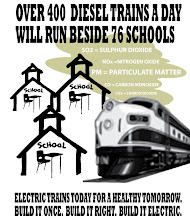
This rail expansion should use electric trains to ensure that significant environmental concerns are resolved, and the expansion of this service does not merely shift the cause of pollution from highways to rail corridors. These rail corridors run beside schools, nursing homes, playgrounds and through residential neighbourhoods. The rights of the citizens who use these services, and live in these areas, should be considered as a major part of the Environmental Assessment process.

Also, the $875 million cost of this project is carried by taxpayers, and should be supported by those who will be affected most as the construction from the expansion disrupts neighbourhoods for years at a time. If the rail expansion is electric, the neighbourhoods will be more likely to support this massive project. The neighbourhoods will have difficulty dealing with the second disruption of their lives, if indeed, the rail corridor is to be electrified in 15 years as promised. Historically, it is rare that major public works are upgraded years after their construction, so this corridor should be built properly the first time as electric.

My specific concerns are as follows:

The hours of operation are cited as 5:30 am to 12:30 am each day. Due to these long hours, it is beholden to Metrolinx, and by extension the Government of Ontario and the Government of Canada, to ensure that these trains are quiet, efficient, and non-polluting, as these hours of business extend far beyond noise restrictions for normal business hours.

The data from the Environmental Assessment of the Georgetown and Newmarket corridors, and the Union-Pearson Rail Link, should be merged and considered as one study as these two corridors, and the rail link, are contained within the very small, area of study entitled 'The Davenport Diamond' by Metrolinx. The Environmental Assessment should consider the proximity of these corridors south of Dundas, and include both lines of the rail expansion and UPRL as part of the overall environmental impact concurrently. Metrolinx has said that they will consider these Environmental Assessments separately, although these corridors are in the same neighbourhood. This does not seem to lead to conclusive data.

Diesel trains create significant CO2, NOx and SO2 and particulate matter emissions. Neighbourhoods are willing to accept the increased traffic (at a projected 300 - 500 trains a day) for the common good, but are legitimately concerned on the effect of this air and noise pollution on their health, welfare, and businesses.

The Metrolinx report states the diesel emissions will affect only 500m from its origin, but as the City of Toronto, and the GTA has become more dense in population, this is affects a very large area and population. The Metrolinx report has not updated its data on the population affected by the expansion to be up-to-date.

Urban planners and transportation analysts also know that traffic expands given the avenues available to it, and that the increased traffic on the rail corridor, airports and highways, will impact the quality of air in Ontario for generations to come. As a result, it should be imperative to construct an electric train now to attempt to offset the carbon emissions of the rail corridor component of this transportation expansion. There will be more than enough adverse environmental affects with the increasing airport and highway traffic in the future of the GTA.

Most countries in the world are developing completely electrified rail systems- including India and the United States- and Canada, as a wealthy nation, should be one of them. Why are we considering a technology which is far behind the TTC street car- an electric train which is already in successfully used throughout the City of Toronto? This rail corridor should set an environmental precedent for transit initiatives to come, as the Lakeshore GO train will be electrified in the near future, and so that these corridors are consistent with the American rail system.

Why is Metrolinx, and by extension the provincial and federal government, not performing international 'best practice' case studies of inner city and suburban transit initiatives to try to mitigate the environmental repercussions of this rail expansion on the GTA? There is nothing 'sustainable' about diesel trains, as cited in the Metrolinx report- just retrograde.

TransitCity, as projected by the City Council of Toronto, has proposed a GO train as the fixed link to Pearson Airport- why are SNC-Lavalin's 140 a day, two engine, refurbished 1950s diesel engines considered as a viable, environmentally sound alternative to the LRT as proposed by the City Council to be provided by the GTA, SNC-Lavalin's proposal was written in the 1990s, and is no longer valid as a solution to this rail link by targeting a limited market for the business class.

It is very important that the projected ridership on this rail corridor is studied in detail, and at this time, for its actual market need, and monitored as it is implemented, so that there is not empty space and excess capacity on these trains. The rail corridor should be also monitored and assessed frequently as it is used, so that its implementation and use are consistent with its environmental and social 'Return on Investment'. This rail corridor should not create more air and noise pollution from its traffic than it offsets.

In conclusion, as global warming continues as the most pressing concern internationally, it imperative that every major infrastructure project is considered with great intelligence, foresight and environmental analysis. This project is of the magnitude of the Big Dig in Boston, which wreaked havoc on Boston for years. Therefore, it is better that more planning and analysis is applied to these infrastructure plans before the project is built, as the cost of this project environmentally will be carried by the generations who live in Ontario for decades to come.

Ultimately, if this rail expansion is made electric, there will be even more jobs created for Ontario workers, and opportunities created for companies, as part of the greening research and development initiatives internationally. This advanced technology and intellectual property can then be exported to become a positive part of our legacy and international corporate reputation.